Disclosure: Our basic pass tickets and a coffee voucher came with a Mercedes-Benz Korea test-drive program we had signed up for. Opinions are my own.
Museum SAN (뮤지엄산), the museum designed by Tadao Ando in Jijeong-myeon, Wonju, can be walked end to end with just the basic pass (KRW 23,000 per adult in October 2026): the outdoor gardens, the main gallery and the Paper Museum. We went on a Friday afternoon at the end of October 2026, and the autumn colors were spectacular. The basic pass alone filled half a day, and my partner and I were both really happy with it.
| Name | Museum SAN (뮤지엄산) |
| Address | 260 Oak Valley 2-gil, Jijeong-myeon, Wonju-si, Gangwon-do |
| Hours | 10:00–18:00 (ticket sales close 17:00); closed every Monday |
| Ticket | Museum SAN basic pass (officially the “basic pass ticket”), KRW 23,000 per adult |
| Not included | James Turrell hall, Meditation Hall, GROUND (Antony Gormley) |
| Time we spent | A little over 1 hour 45 minutes (by photo timestamps) |
| When we went | Friday afternoon, October 30, 2026, my partner and I |
| Paid by | Voucher from a Mercedes-Benz test-drive program, exchanged on site |
Hello, I’m Hogal, a marketer who runs on curiosity. Today’s story is about the autumn leaves at Museum SAN, where we went walking in Wonju. A full loop of a museum designed by Tadao Ando, on one basic pass. The autumn colors are absolutely stunning.
Prologue: These days autumn is so short it barely gets a full name
On Friday, I took a day off. It was the day of the Mercedes-Benz test-drive program I had booked during a date in Seongsu in early October: you pick up a Mercedes-Benz E200 in Seongsu and drive to Wonju and back. When I said I was taking a day off to go to Wonju, my teammates were very jealous. (This post is going to be the evidence of that bragging. Ha.)
Autumn is far too short these days. In Korean, autumn is “gaeul,” and people joke that it is now so short it is just “gal,” as if the season has been cut off mid-word. Before that short autumn ended, this was the day we went to catch the autumn leaves at Museum SAN.
The car park was full, and we were 11th in the ticket line
The stone sign wall, with the mountain-shaped logo, stood among the red maples. It was a Friday in foliage season, so there were lots of tour groups, and the Museum SAN car park was full.
Our admission was the voucher we got from the test-drive program, which has to be exchanged for a paper ticket at the ticket booth. We took a picture of the instructions on the back of the voucher, our queue ticket and the paper tickets we got in exchange. Queue ticket number 333, with 11 people waiting. Even so, it took only a little over 7 minutes until the tickets were in our hands (going by the times on our photos).
What the Museum SAN basic pass covers, and what it does not
A fee board by the ticket booth lists each ticket type, with photos of the separate halls. There are three places the basic pass does not get you into: the James Turrell hall, the Museum SAN Meditation Hall, and Antony Gormley’s GROUND. To give you the conclusion first, my partner and I were really, really happy with the basic pass. Ha.
| Ticket (adult, from the board at our visit) | What it covers | Price |
|---|---|---|
| Basic pass | Outdoor gardens + Paper Museum + art gallery | KRW 23,000 |
| James Turrell, Meditation or GROUND pass | Basic + 1 hall | KRW 39,000 each |
| Special passes 1–3 | Basic + 2 halls | KRW 49,000 |
| Signature pass | Basic + all 3 halls | KRW 59,000 |
The three separate halls run on reservations: you book an entry time when you buy the ticket, and additional tickets are issued at the print workshop.
Autumn leaves that start in the Sculpture Garden
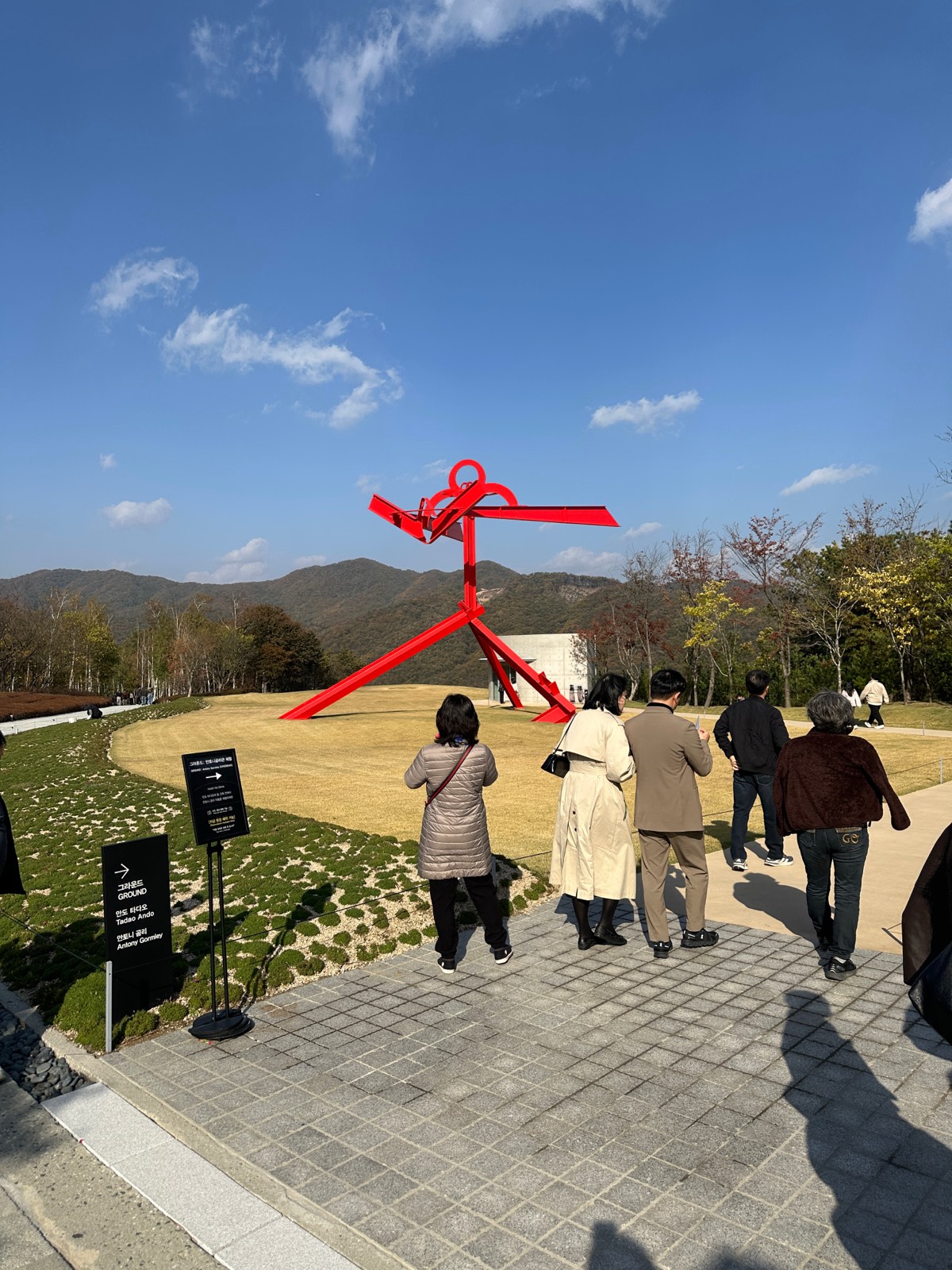 A red steel sculpture; around it, a tree with yellow berries, red shrubs and the column sculpture Cascade.
Once you pass the Art Shop and Cafe, this is where the Museum SAN autumn colors begin. Green, yellow, red and brown are all mixed into one view. Beyond the grassy hill, mountain ridges stack up layer upon layer. The column sculpture is Eric Orr’s Cascade.
The Water Garden, today’s best shot
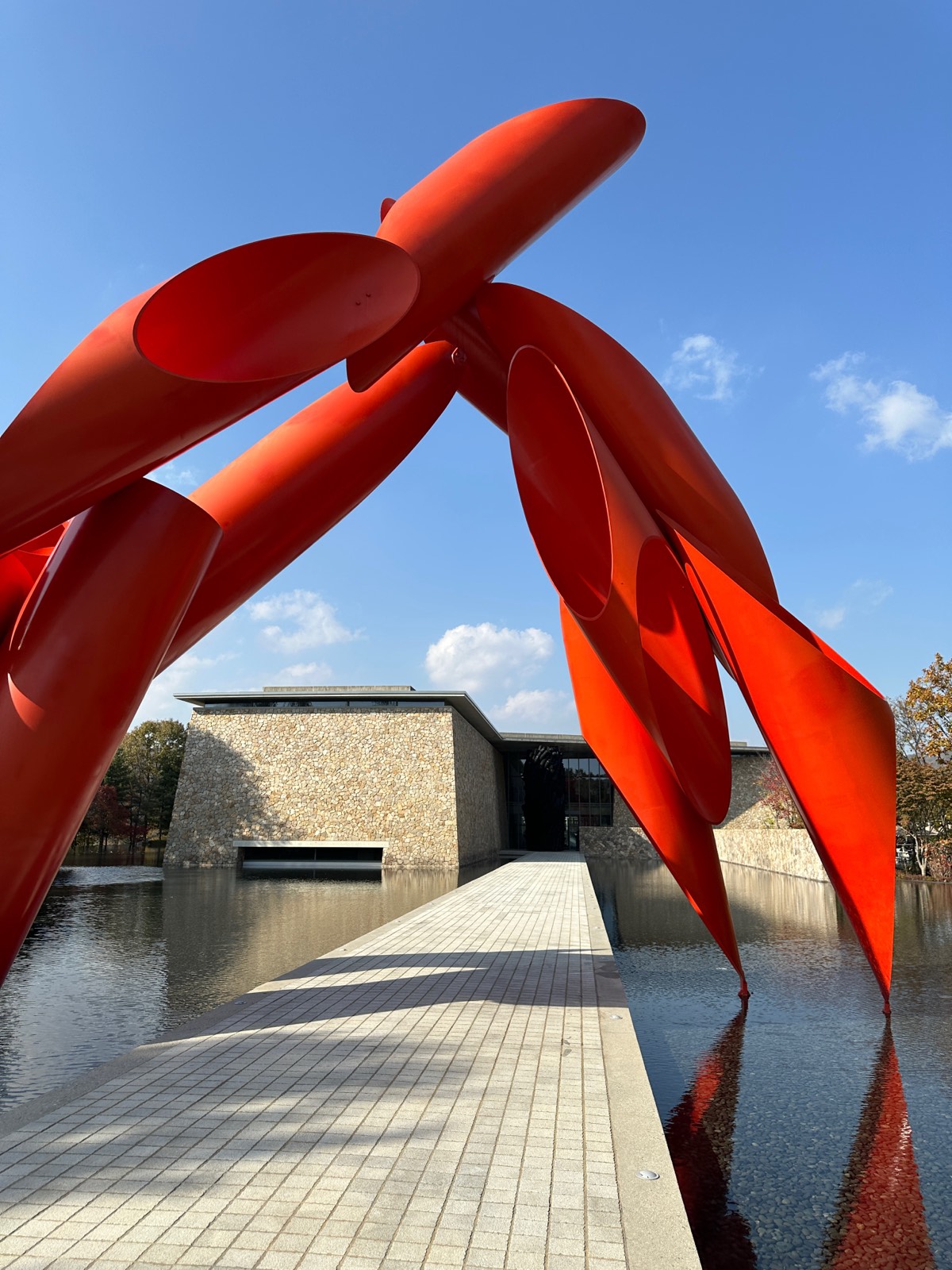 A red arch sculpture over the path across the water, and the stone main building.
A path running straight across the surface of the water, a red arch sculpture hanging over it, and at the end of the path the main building, built of stacked stone. Even the red reflected in the water fits into a single shot. Everywhere your eyes land is a photo spot, and even the weather was insanely good.
The main building: Lee Bae: En attendant
This year’s featured exhibition is Lee Bae’s solo show, Lee Bae: En attendant (Lee Bae: Waiting), running from April 7 to December 6, 2026. We passed the title wall of the solo show, and over the large painting Brushstroke in the lobby, the shadow of the window bars was drawing diagonal lines.
A white gallery you walk in your socks
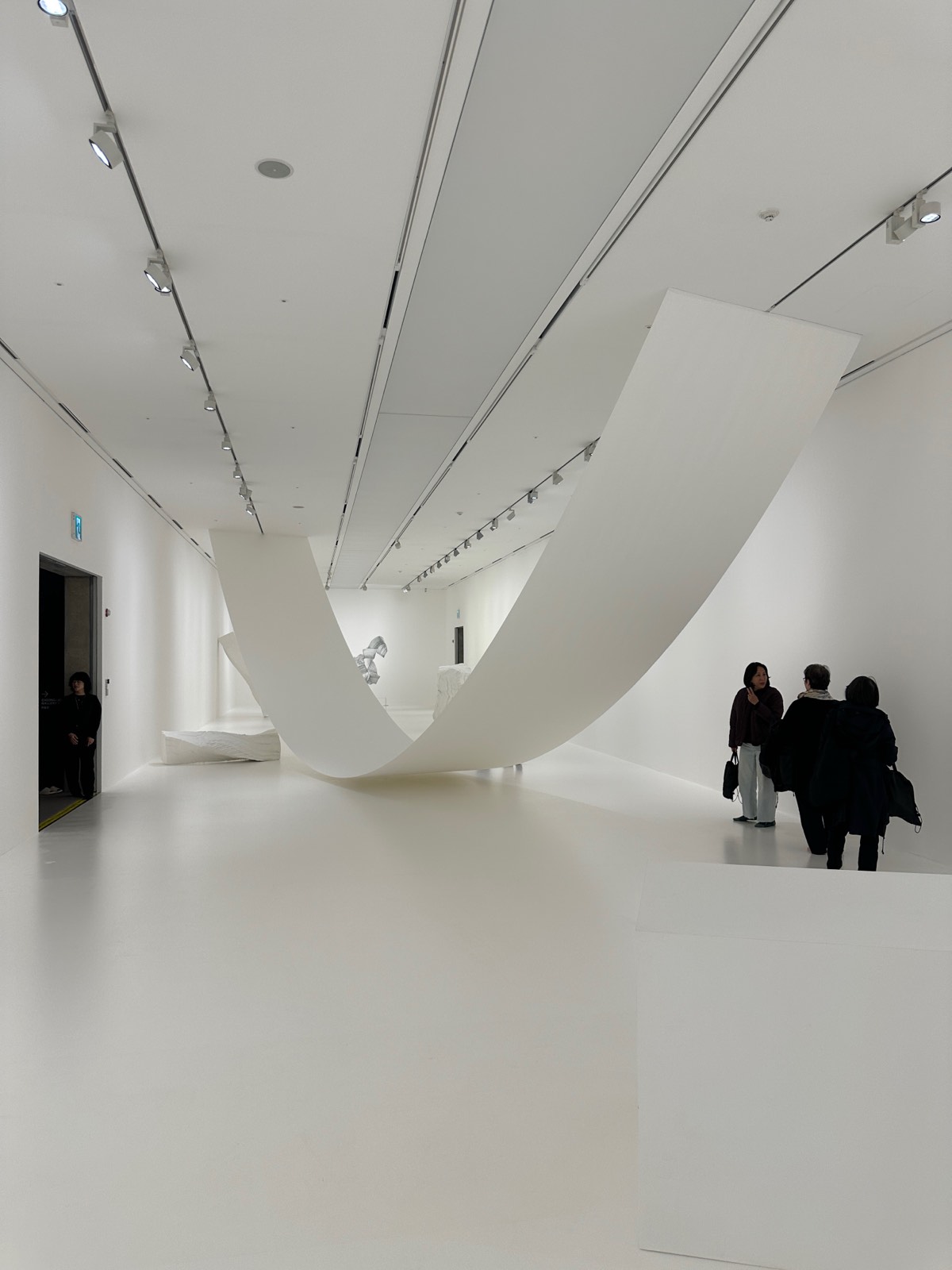 A white band hanging in a U shape; I also took a photo of our two pairs of socks on the white floor.
The Cheongjo Gallery has a section you enter with your shoes off. A room where the floor, the walls and the ceiling are all white. We both walked it in our socks. And I briefly regretted coming in high-top Converse. Ha. (The gallery leaflet says shoe covers are available too.)
A heap of charcoal, and a making-of film at the end
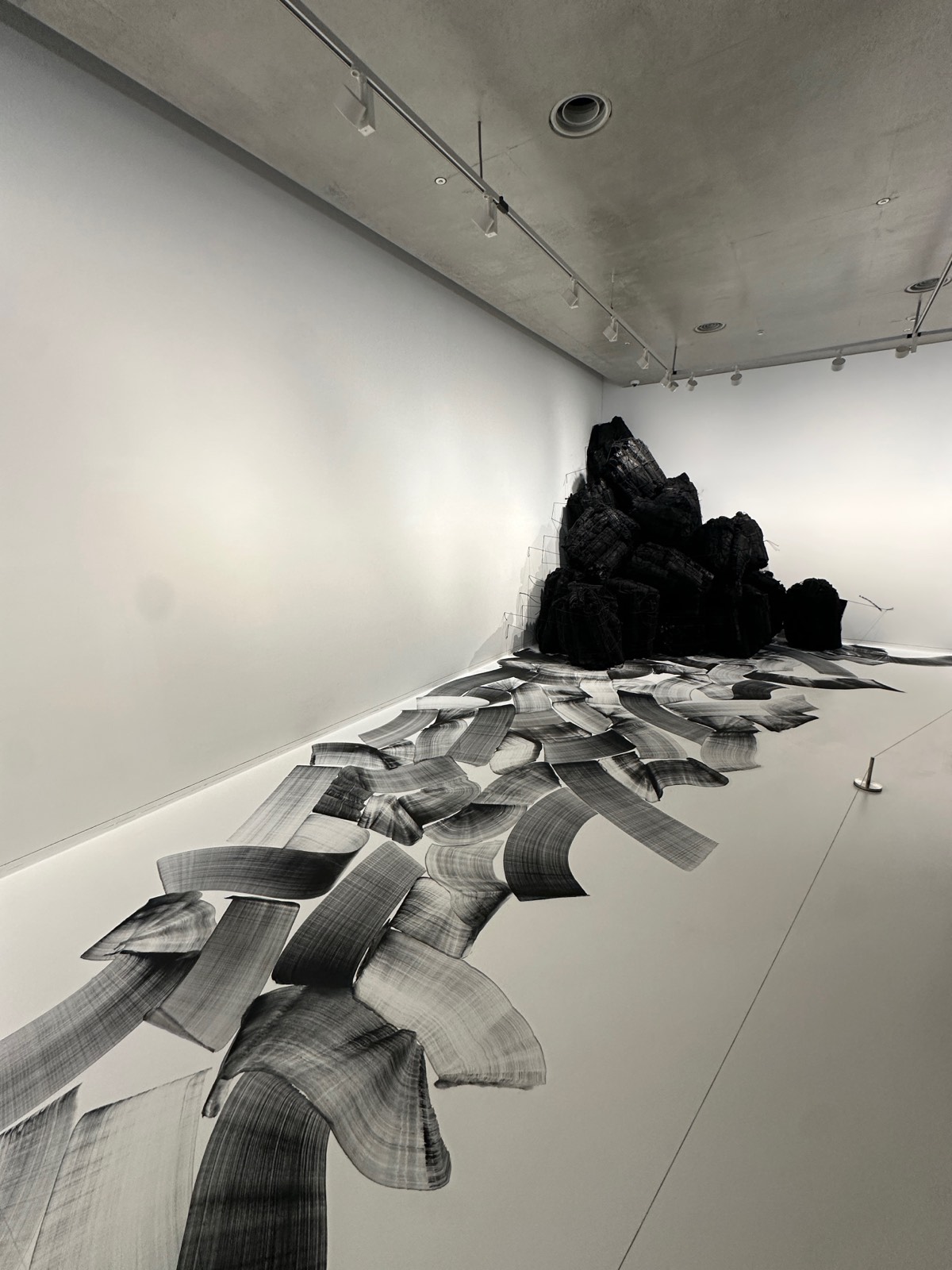 A heap of charcoal at the end of the brushstroke papers; in the next room, a four-panel black painting with a silvery sheen.
Step out of the white room and it is black again. Brushstroke papers flow along the floor and stop in front of a heap of charcoal. There are really a lot of Lee Bae’s works. And in the last room you come across a film of the making process.
So that is how the works we had just walked past were made. It was astonishing.
The Nam June Paik hall is not large, so I took it in with my eyes instead of photos.
The Stone Garden: I was in Seoul just yesterday
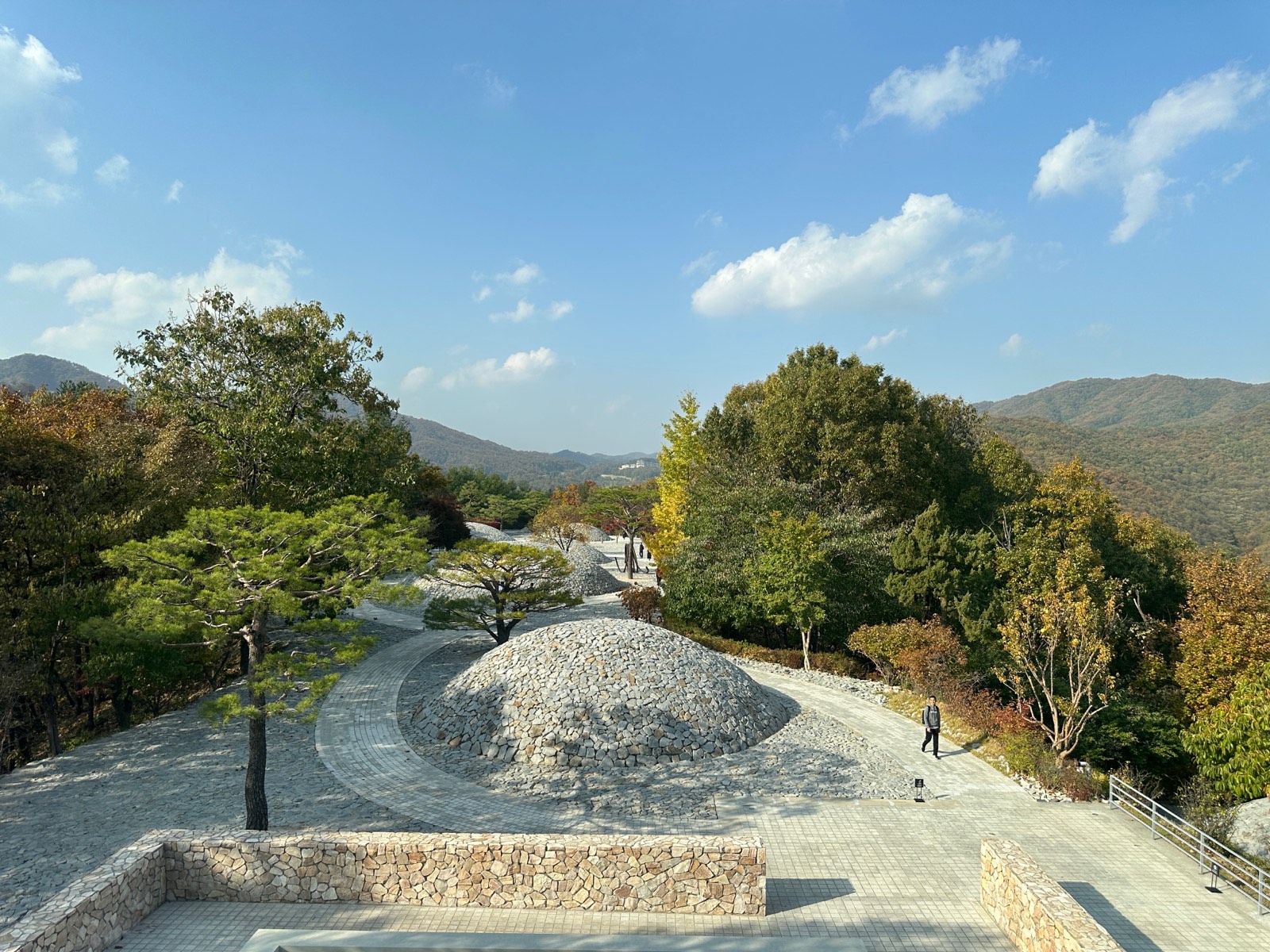
When you leave the gallery, you look down on the Stone Garden. These are stone mounds modeled on the lines of Silla-era royal tombs (according to the brochure).
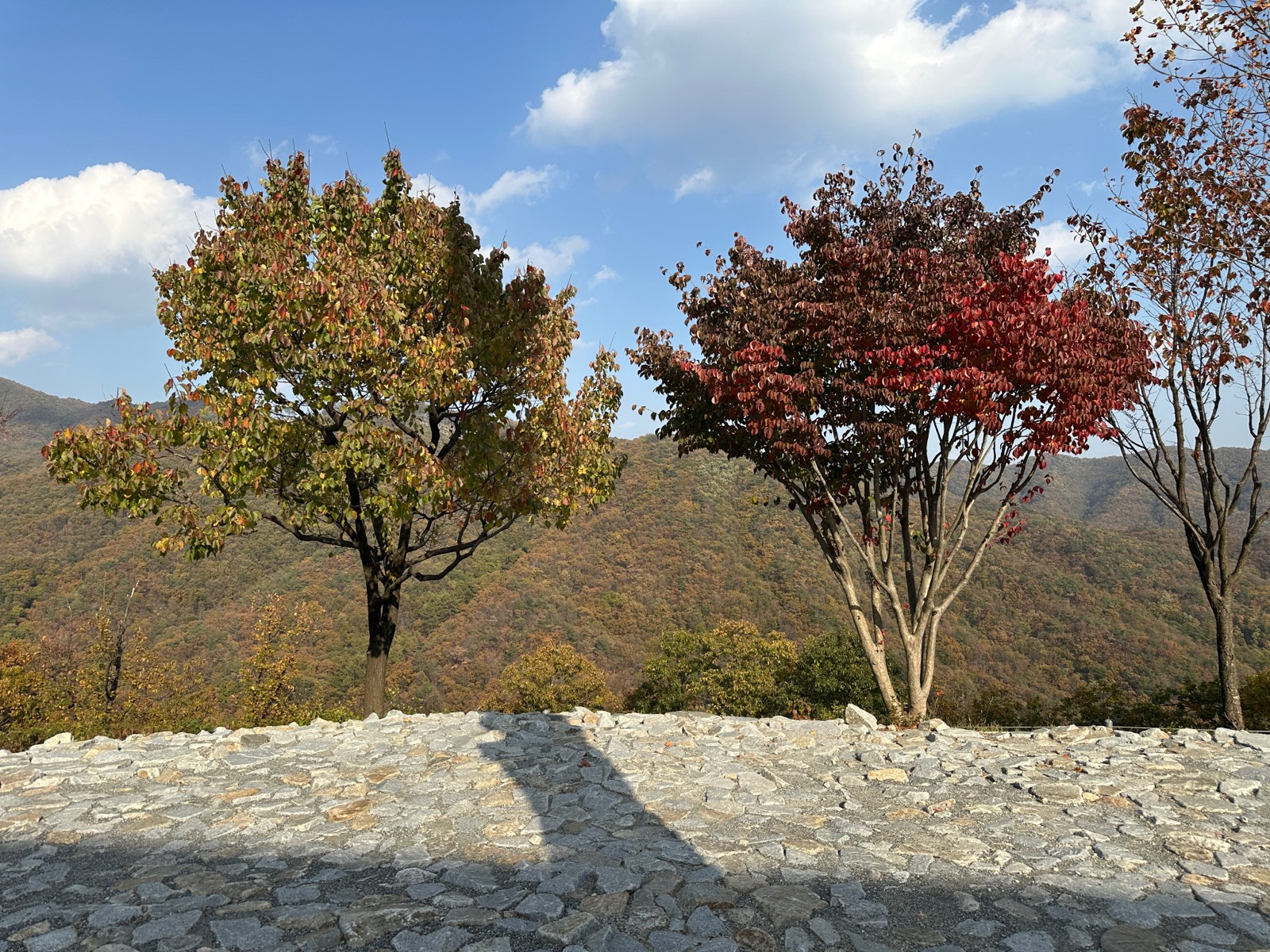 Green, orange and red trees on a stone terrace; nearby, a bright yellow ginkgo.
On the way there, the Museum SAN foliage stood in a single row. Green, yellow, red. Looking at the layers of mountains, I wondered whether I had really been battling it out in the middle of Seoul until yesterday.
From the end of the garden you can look down on a golf course in the valley, with a road curving along the autumn hillside. On the green, there were middle-aged guys playing golf. In that moment I made a vow: when I retire, I will spend a relaxed old age going golfing. Ha.
Back to the papyrus greenhouse
From the Stone Garden, back to the main building. The first gateway to the Paper Museum is a papyrus greenhouse, with papyrus and an explanation board behind the glass. The word “paper” is said to come from this plant. The two of us reflected in the glass came as a bonus.
The Paper Museum: meeting paper
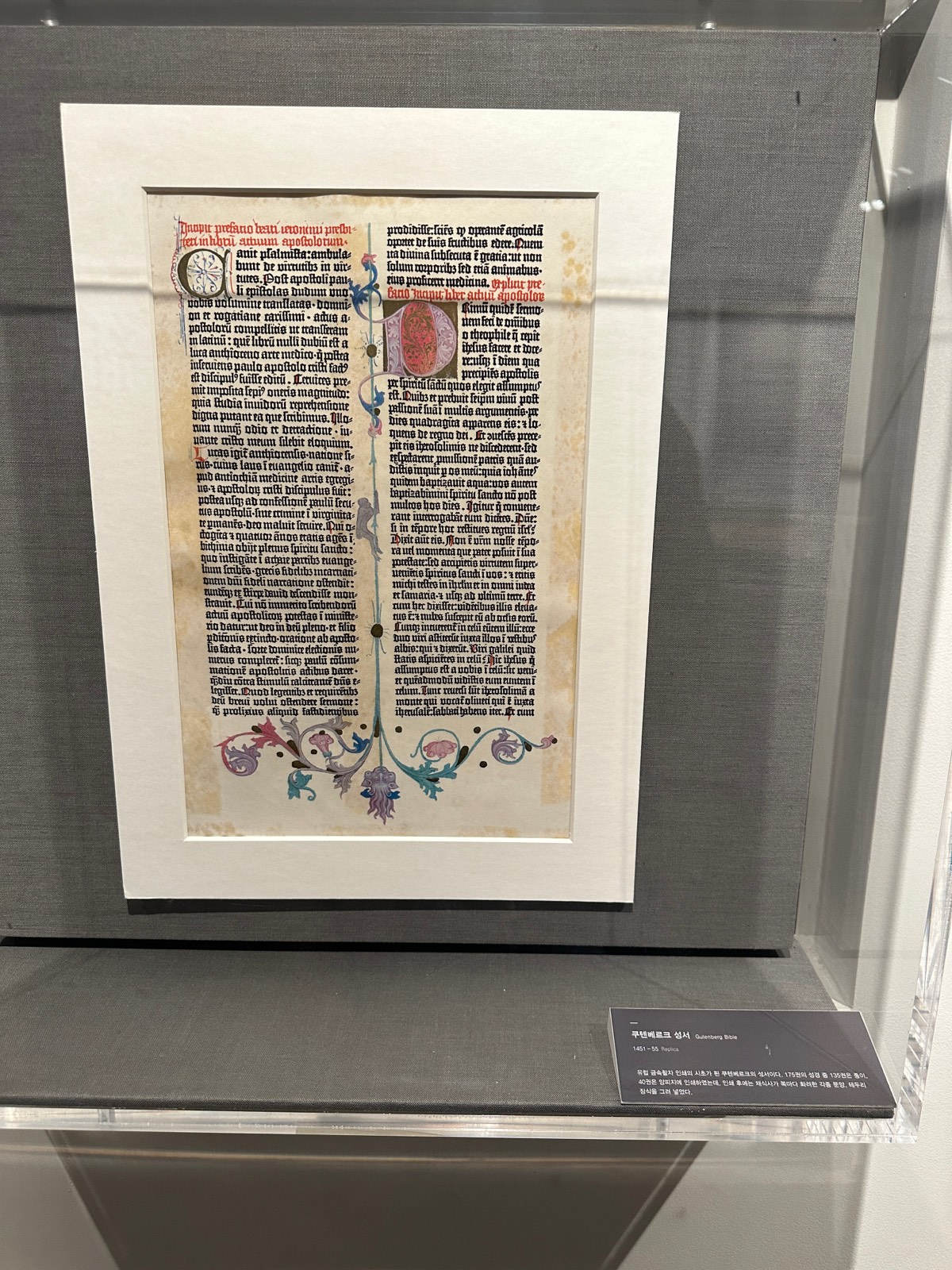 A Gutenberg Bible replica; the room opens with the title “紙, meeting paper,” and a Hollander beater stands nearby.
Gallery 1 starts with the birth of paper: clay tablets, Cai Lun’s invention of paper, the Gutenberg Bible, and the Hollander beater. You follow, in order of time, how humans have kept records.
The next room has everyday crafts made of paper. Under a spotlight in the dark sits a 19th-century tiger-shaped paper pillow with its mouth wide open; it is said to have been made with a wish for a long life. (People slept with their heads on a tiger with its jaws wide open. Ha.)
Last stop: Hansol Paper’s Ilsang Hansol
Gallery 4 of the Paper Museum is Ilsang Hansol (Everyday Hansol), an exhibition by Hansol Paper, running until December 20, 2026. Past a title wall on wooden pillars, there are four K-pop Demon Hunters Shin Ramyun cups, a bhc chicken box and thermal receipt paper. The papers we hold in our hands every day have become exhibits. It is a flow that starts with clay tablets in Gallery 1 and ends with a chicken box in Gallery 4.
Using the coffee voucher too, down to the last drop
We finished at the Cafe Terrace. We made full use of the coffee voucher too, and that was the end of the experience. (The story of the apple cake that went just KRW 1,000 over our two vouchers is in a separate Korean post. Ha.)
The Museum SAN route we walked that day went from the Sculpture Garden to the Stone Garden, then back to the main building, ending at the Paper Museum.
The Hogalog summary
Best picks: the red arch in the Water Garden, and the Museum SAN foliage on the way to the Stone Garden.
How to enjoy it: Sculpture Garden, then the Water Garden, the Lee Bae exhibition, the Stone Garden, the papyrus greenhouse, the Paper Museum and finally the Cafe Terrace.
Recommended for:
- People who want autumn leaves and architecture in one day during the short autumn
- Anyone looking for somewhere to walk slowly with their parents
- First-timers who want to get a feel for the place with the Museum SAN basic pass first
Visiting tips:
- You take your shoes off to enter the white gallery (shoes that are easy to take off and put on are recommended).
- On a Friday afternoon in foliage season, the car park was full and there were 11 people waiting at the ticket desk.
Epilogue: At the very end of autumn
The autumn leaves in the Sculpture Garden, the red arch over the water. The white room we walked in our socks, the golf course beyond the Stone Garden. The Museum SAN basic pass alone filled half a day.
My partner said next time we should bring both sets of our parents. That made me quietly proud.
Lunch that day was on the way to Museum SAN, near Oak Valley. (It is a place where a serving robot brings out your steak. Ha.) I have also written, in Korean, about that lunch, an autumn drive along the Bukhangang River, and the Mercedes-Benz E200 we drove that day.
My thanks to Mercedes-Benz Korea for planning such a wonderful day as a course.
That this was the very end of autumn, walking through the Museum SAN foliage in a “gal” so short it is all the more precious.
Thanks for reading, and your likes and comments always help me keep going.
Read the original Korean review on Naver (with all photos): 뮤지엄산 단풍 기본권 동선 정리, 가을의 끝자락에 걸은 조각정원부터 종이박물관까지