Menshoku COEX (멘쇼쿠 코엑스점), on the B1 floor of City Airport Tower across from COEX, is a ramen shop run directly by Menshoku’s flagship, and on a weekday lunch you can walk straight in. The KRW 13,000 shoyu ramen has a clear broth that does not lead with salt. It is not a ramen that brands itself on your memory with a strong personality; it is closer to a lunch that does not let you down.
| Restaurant | Menshoku COEX (멘쇼쿠 코엑스점) |
| Category | Japanese, ramen |
| Address | B03, B1, City Airport Tower, 36 Teheran-ro 87-gil, Gangnam-gu, Seoul |
| Getting there | Between Samseong Station (Line 2) and Bongeunsa Station (Line 9), on the B1 floor of City Airport Tower across from COEX |
| Hours | Opens 11:00 |
| Price | Ramen KRW 13,000–17,500; rice bowls KRW 13,000–14,000 (September 2026) |
| Recommended | Shoyu ramen, full topping ramen, special tempura rice bowl |
| Booking and ordering | No reservation; we walked in, and you order at a kiosk |
| Seating | Counter seats, bar table, single seats and regular tables; a group-seating sign by the entrance |
| Facilities | Waiting area, separate men’s and women’s restrooms, wheelchair accessible, a Food Safety restaurant designated by Korea’s Ministry of Food and Drug Safety |
| Parking | Free 1 hour with KRW 50,000 spent, 2 hours with KRW 100,000, 3 hours with KRW 150,000 |
| @men_shoku | |
| When we went | Lunch on Thursday, September 17, 2026 (my second visit), four of us from work; we paid for our own meals |
Hello, I’m Hogal, a marketer who runs on curiosity. This is my honest review of Menshoku COEX, a ramen shop on the B1 floor of City Airport Tower. Four of us from work went there for lunch on Thursday, September 17, 2026, and we paid for our own meals. For me, it was the second visit.
Prologue: My third review from the same basement floor
This is my third review from the B1 floor of this building. My office is nearby, so my lunch routine repeats every week, and it felt like a waste to let it slip by. So I set one rule: I only write about places I have been to at least twice.
I have already covered two places from the same corridor: Brickurry, where I had hamburg steak and the lunch line moves quickly, and Seoul Kkakdugi, a Korean beef bone soup (seolleongtang) restaurant I have been to three times. Menshoku, today’s review, is the third. All three are on the same B1 floor of City Airport Tower; walk along the corridor and you pass them one after another. If you have ever searched for ramen near COEX, you have probably seen the name.
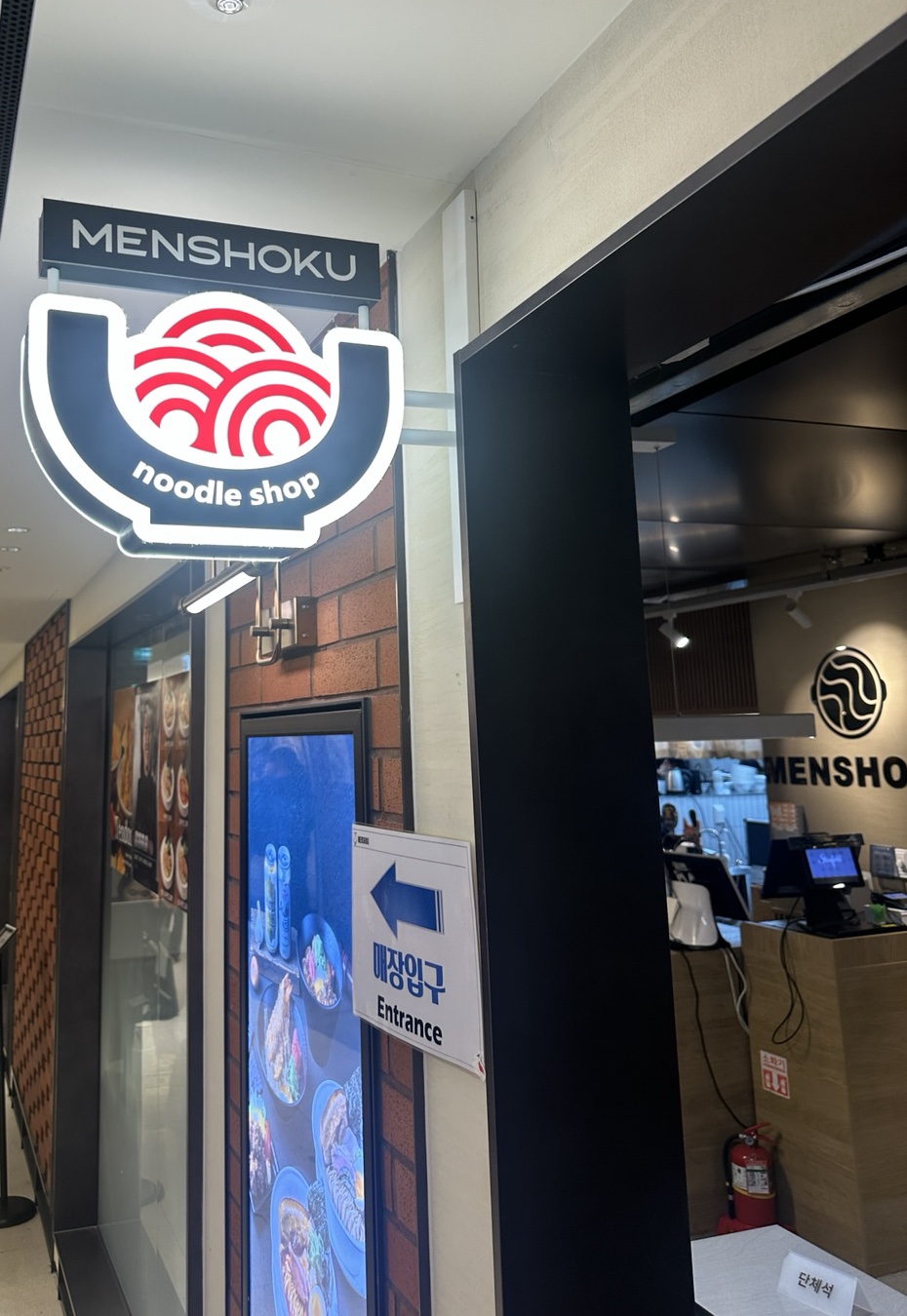 The sign with its red noodle logo, next to an entrance arrow in Korean and English.
Next to the sign, a digital signage screen keeps cycling through photos of the menu. On the wall beside the entrance there is a separate notice about group seating.
Three candidates, and the deciding factor was not taste
That lunch was a mixed group from several teams, and a new colleague came along too. We started deciding on the menu at around 11:00, and the answer came at 11:11. It took exactly ten minutes.
First, one coworker put up two candidates: a place over in Cheongdam famous for its mala chadol jjamppong (a spicy noodle soup with mala spice and thin-sliced beef brisket), and this one. But the line that came right after was the real subject of the conversation: “This is the only place I know where you don’t have to wait.”
Another coworker immediately explained why, and spot on: “There aren’t many places around COEX where you can eat without waiting…”
Cuchara came up for a moment as the third candidate. It is a Mexican place, and honestly, if you asked me to name a place in this neighborhood where you never have to queue, it would come first. “For no-wait, Cuchara really is the best.” But we had already been there a lot, so it was less tempting, and I cast my vote for the ramen place: “If it’s Cheongdam versus ramen, one vote for ramen!”
The new colleague wrapped it up: “Then shall we go to the ramen place??!!” And that was that.
Looking back, none of the three candidates were competing on taste. All three had passed the same test, “no waiting,” and within that we simply chose by mood.
Under a black exposed ceiling, the open kitchen and order counter are visible at a glance. Our lunch break is one hour. Ten minutes to walk there and back, five minutes to order and get your food, and you have a little over forty minutes at the table. Add a twenty-minute wait, and half of lunch evaporates in the corridor. That is why, for office workers here, “a good restaurant” and “a restaurant you can actually get into” mean different things. Ratings do not tell you how long the line is.
A marketer’s view: a TV chef’s brand with no line
It is a TV chef’s brand, yet there is no line at lunch. Honestly, I did not watch season 2 of that show. All I know is that the coworker I went with told me the chef had been on it, so I cannot tell you what was shown. I did at least know it was a chef’s brand.
The restaurant’s Naver Place description makes the structure clear: a directly run branch of the flagship near Sinsa Station, known for house-made noodles, with a line of rice bowls added to the ramen. In other words, it is run directly by the flagship, not franchised. It borrows the recognition the flagship built, but the queue that piles up at the flagship does not follow it here. The fame moved in; the wait stayed behind.
The numbers say the same. This is a restaurant with 481 reviews on Naver Place, and only 5 of them mention waiting time among the review features, against 99 for taste and 60 for satisfaction. That is next to nothing. The second most voted review keyword is “good for eating alone,” with 45 votes. All through lunch, people keep coming in alone, sitting on a bar stool, slurping down their bowl and leaving. In the table area, three pendant lights hang over the tables and posters of menu photos cover the wall.
But we went as four, a group in a restaurant optimized for solo diners, and once we sat down it was not uncomfortable at all. Menshoku’s seating layout is actually pretty good. Some four-person tables can take five or six people with an extension table. There are quite a few regular four-person tables as well, and on top of that there are single seats. Solo diners go to the counter, groups take tables, and bigger groups push tables together. The group-seating sign they bothered to put up at the entrance probably comes from the same thinking.
I will note the shadow side too. Among the reviews there is a harsh one from a longtime customer of the flagship. It says the branch felt heavily factory-like, the chashu was too sweet and did not belong with the rest, and the duck was sliced as thin as paper. It ends by saying it was not worth paying KRW 17,000. To be fair, to handle lunch turnover in a basement food court, something has to be standardized somewhere. But I have never been to the flagship, and I left satisfied that day.
Shoyu ramen for KRW 13,000, and extra noodles as the answer
What I ordered was the basic shoyu ramen. KRW 13,000. Ramen prices here start at KRW 13,000 and go up to KRW 17,500 for the full topping ramen. Baek ramen and hong ramen are KRW 13,500 each, and shio ramen is KRW 13,000.
| Menu (September 2026) | Price |
|---|---|
| Shoyu ramen | KRW 13,000 |
| Shio ramen | KRW 13,000 |
| Baek ramen | KRW 13,500 |
| Hong ramen | KRW 13,500 |
| Full topping ramen | KRW 17,500 |
| Rice bowls | KRW 13,000–14,000 |
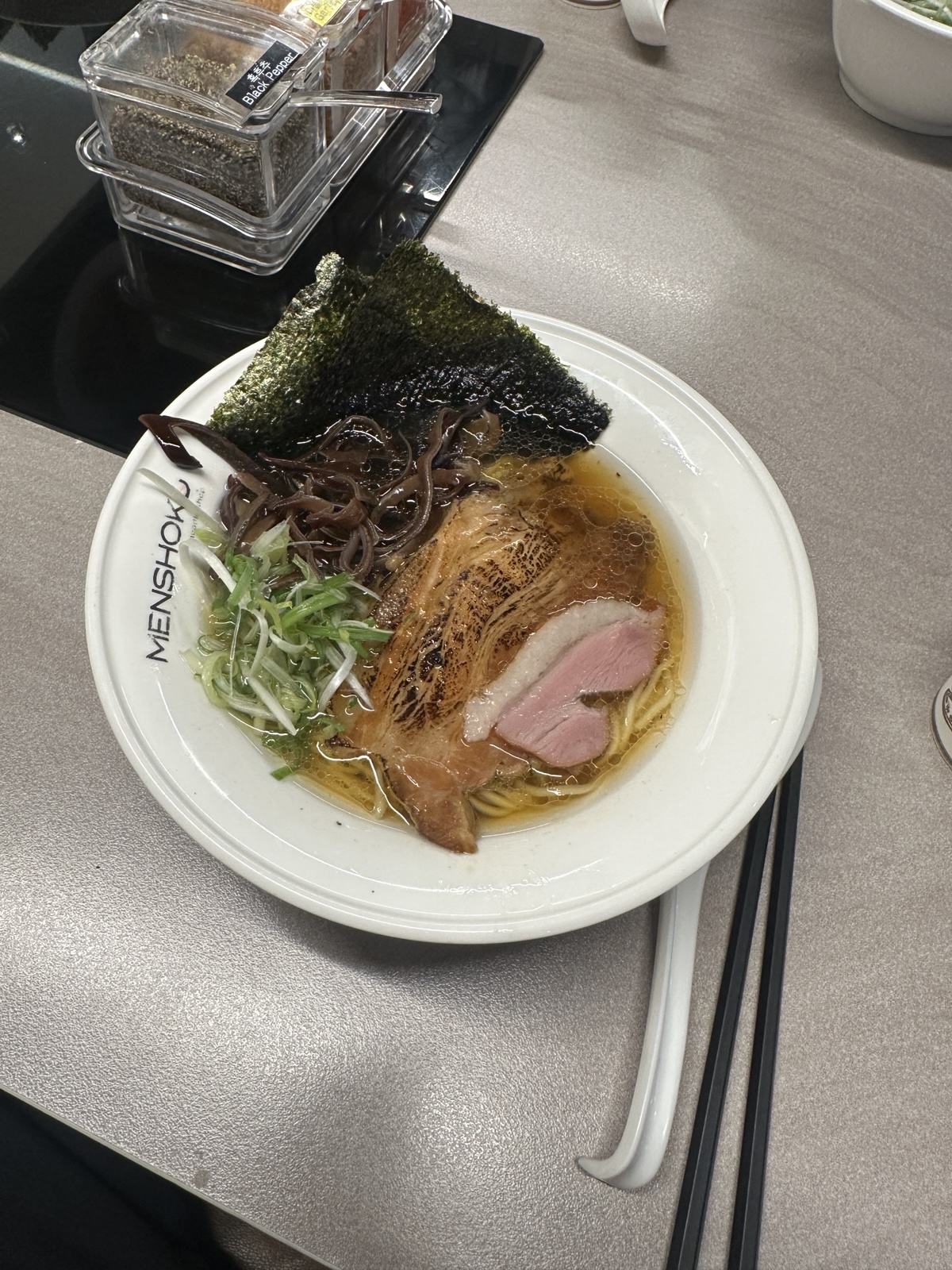
Do not expect a milky broth like tonkotsu. It is a clear golden color, clear enough to see the bottom of the bowl, with round drops of oil spreading into a thin layer on the surface. The two slices of chashu have completely different personalities. One is pork belly chashu, torched on the outside until the grain splits; the other is duck chashu, still pink inside. On top go a handful of wood ear mushrooms, a heap of shredded green onion and a sheet of nori standing upright. The rim of the bowl is stamped with the Menshoku name.
It was good.
It is not a bowl that knocks you out with one punch. The broth is chicken stock with soy sauce for savoriness, so the soy sauce does not step forward; it supports from behind. Because the salt does not hit first, I did not tire of it all the way to the bottom of the bowl. The noodles live up to a flagship that made its name on house-made noodles: thin and straight, but chewy and springy as you bite through. It is not a ramen that brands itself on your memory with a strong personality; it is closer to a lunch that does not let you down. That said, some reviews say the opposite, that it is too salty, so if you are sensitive to salt, keep that in mind.
You may find the portion small. That is not just my impression; it comes up again and again in the reviews. One reviewer actually wrote that the portion left them wanting to tip rice into the broth. Fortunately, this place has an answer ready for that complaint: extra noodles are on the menu.
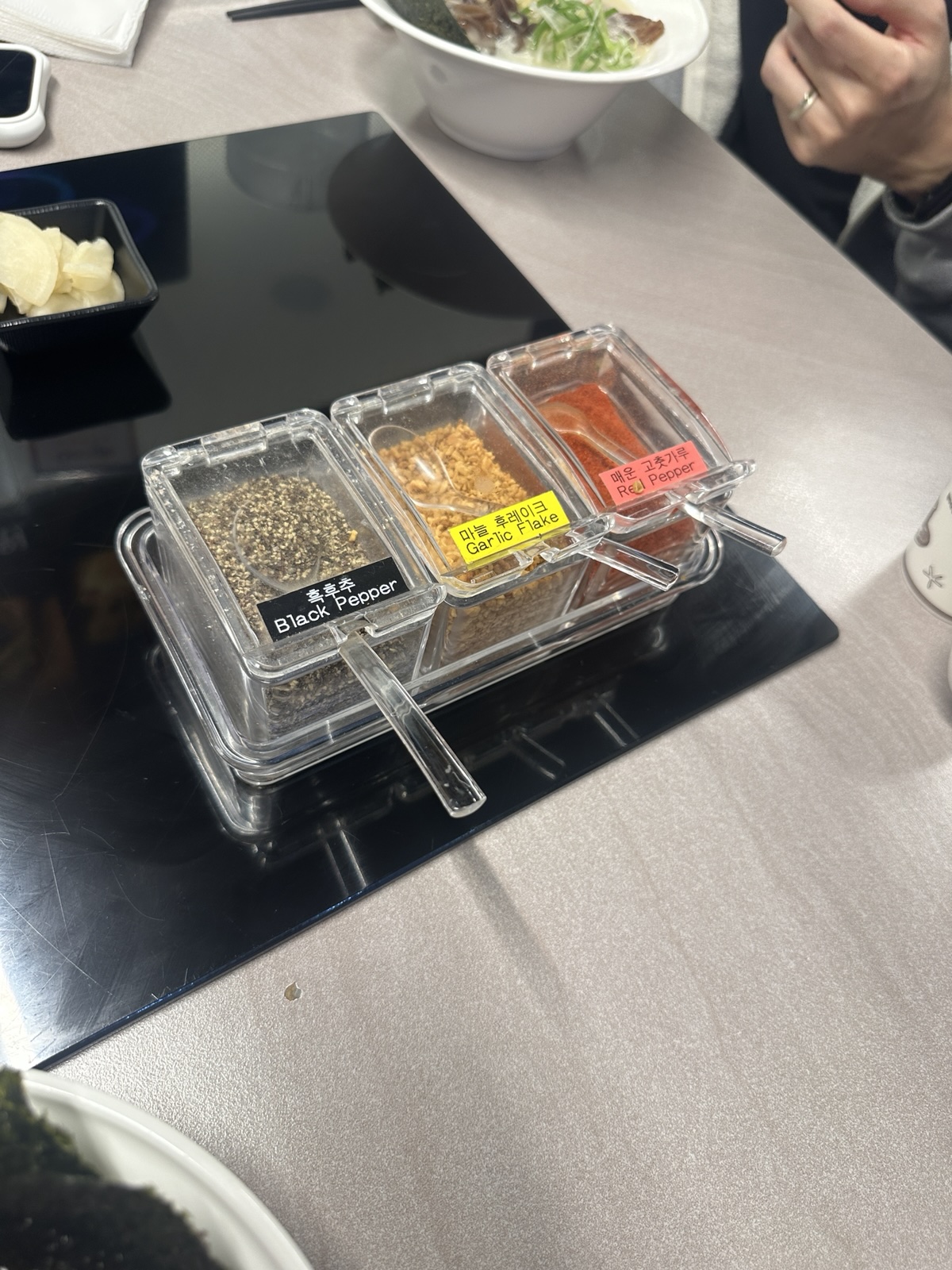 Black pepper, garlic flakes and hot red pepper flakes, labeled in Korean and English.
The table condiments are this place’s secret weapon too. Three containers, black pepper, garlic flakes and hot red pepper flakes, come together on a single tray. Each one is labeled in both Korean and English, labels clearly made with foreign customers in mind. Of the three, you can treat the black pepper as the signature: the broth is on the clear side, so there is plenty of room for pepper. Next to them is a self-serve spot for yuzu danmuji (pickled radish). Take some to your table and nibble on it between bites.
In one of my photos, the hall is full for lunch and there is one extra plate in the middle of our table, holding nothing but noodles. That is the trace of a planner in our group who ordered extra noodles and finished every last strand. (If you are worried the portion will be small, just remember that plate.) The basic bowl is a good amount for a light meal, and if you want to be properly full, add extra noodles.
Epilogue: If you are craving ramen at COEX
This series is not me showing off my neighborhood. It is closer to a guide for people who come for a trade fair or an exhibition and then wander around at lunch. Brickurry, Seoul Kkakdugi and this place are all records from the same B1 corridor.
The three serve different purposes. When you need to eat alone and get out fast. When you need somewhere that opens early in the morning. And when you want an easy, safe meal with someone you have just met.
This place is strongest at the last one. There are single seats so you can come alone, push the tables together and six can sit, and above all, you do not wait in the corridor. On top of that, you get a conversation piece: it is a chef’s brand from TV. For filling ten awkward minutes with someone you have just met, few topics work better.
If you are looking for ramen near COEX, it is worth putting on your list, all the more so if you count the time spent in line.
That, somewhere along the way, my standard for picking a good restaurant had stopped being taste.
When you choose a place for lunch, which do you look at first, the taste or the wait? Thanks for reading, and your likes and comments always help me keep going.
Related
- Seoul Kkakdugi COEX: Seolleongtang Near Samseong Station
- Gangnam Sashimi and Fried Chicken: Singsingi Yachae Makhoe
Read the original Korean review on Naver (with all photos): 1인석까지 갖춘 혼밥 라멘집에 넷이 들어간 도심공항타워 코엑스라멘 멘쇼쿠 내돈내산 후기