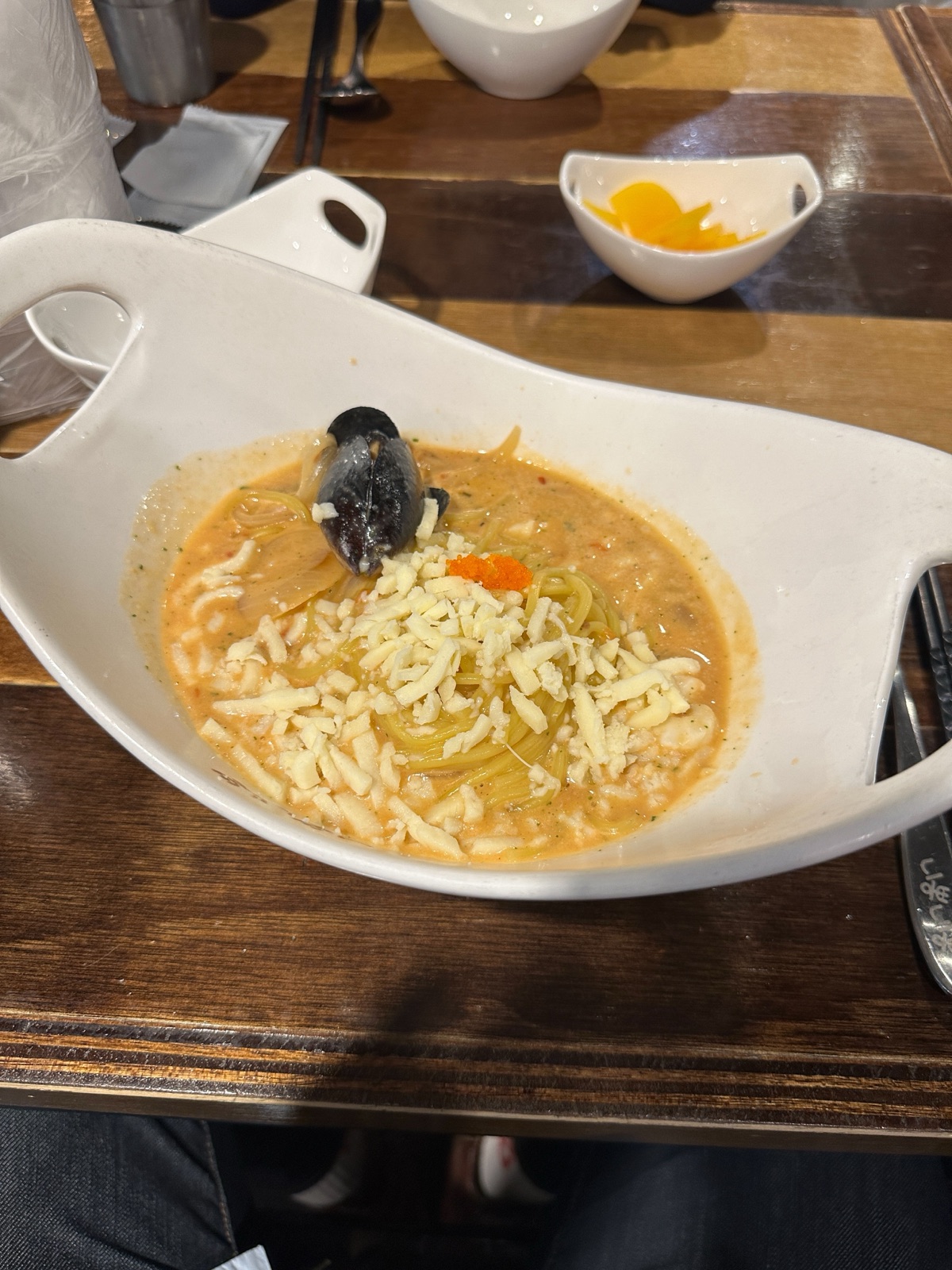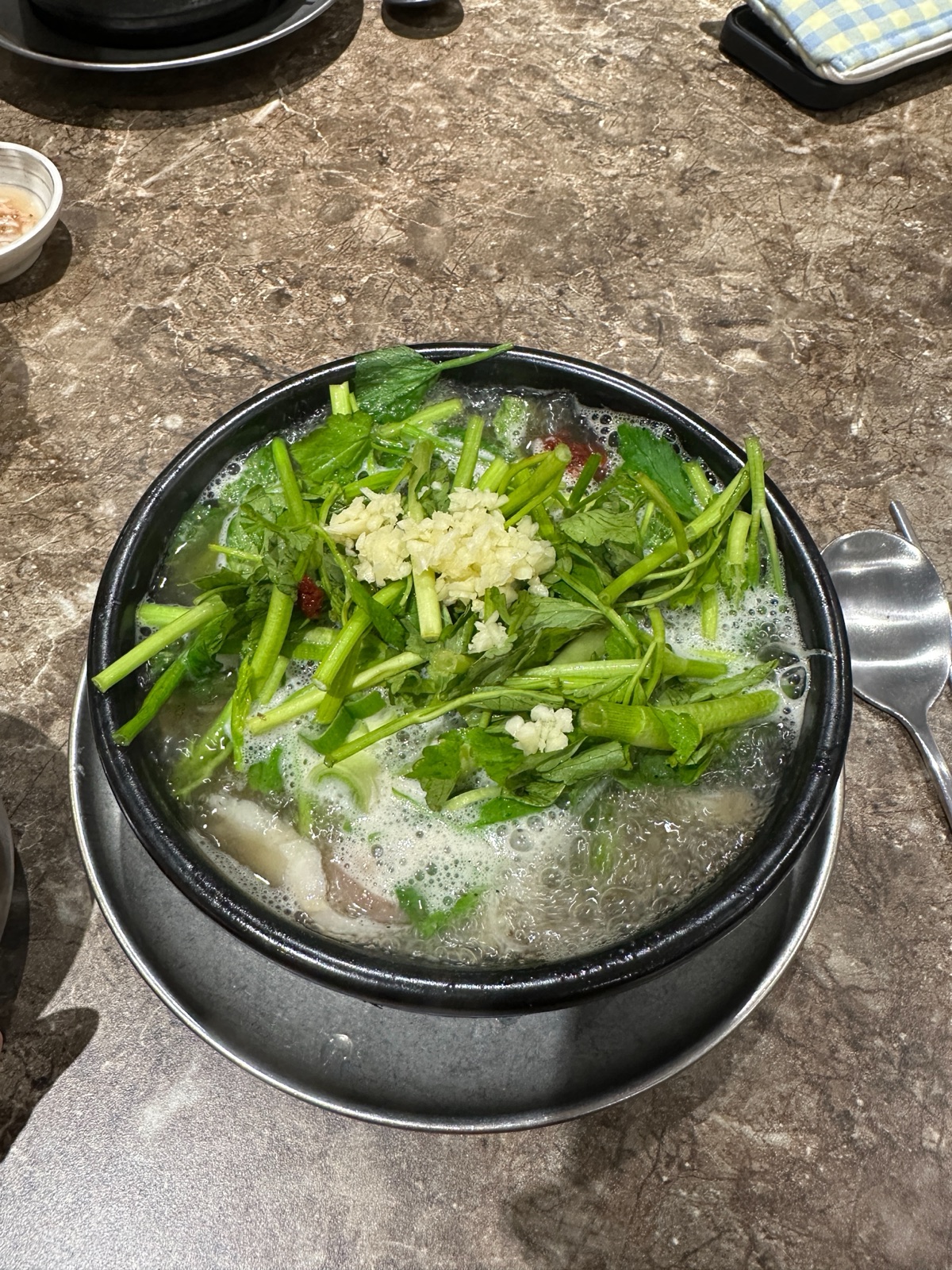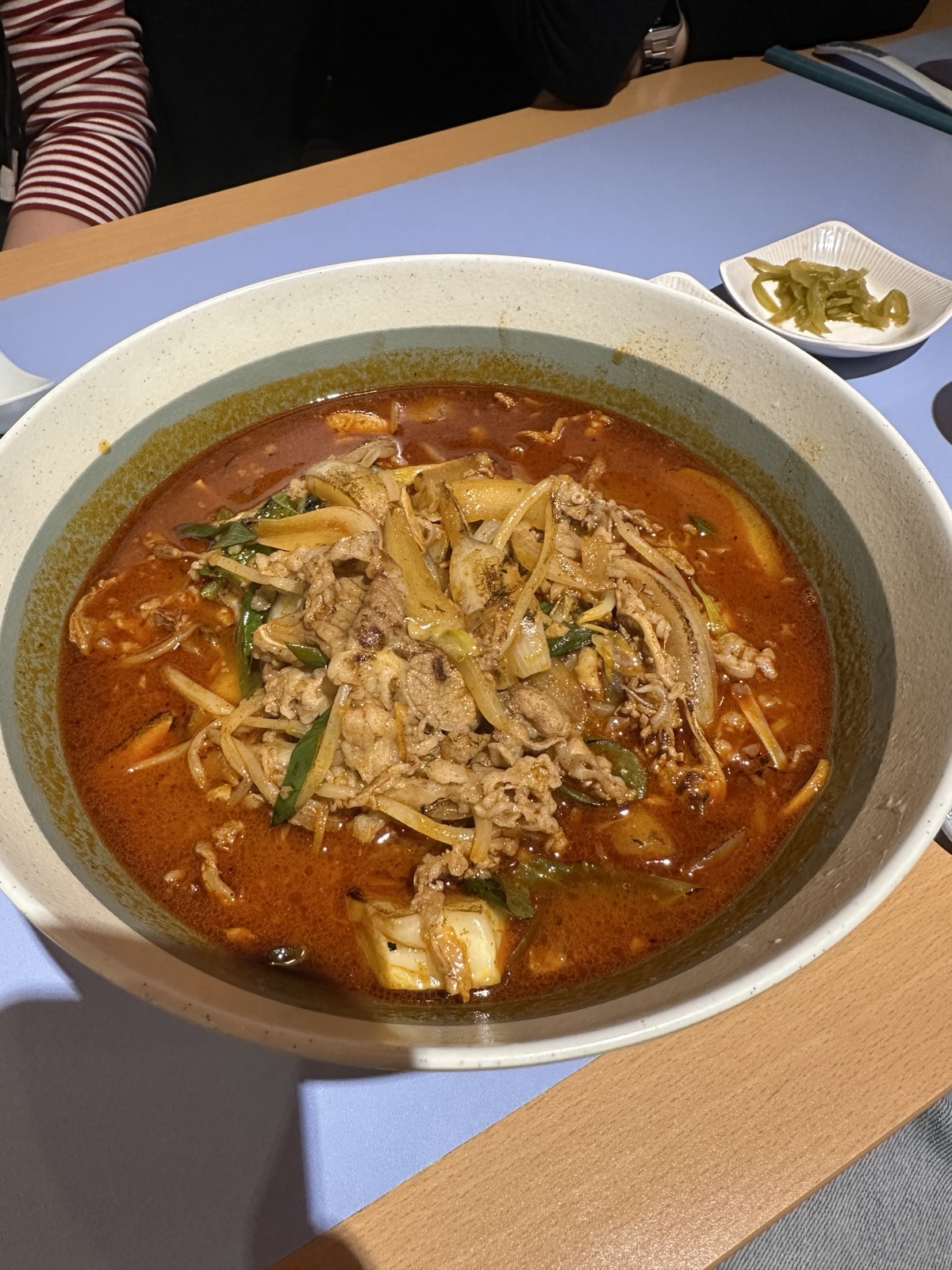
Seoul Kkakdugi COEX (서울깍두기 코엑스점) is a seolleongtang (beef bone soup) restaurant on the B1 dining floor of City Airport Tower, 555 m from Samseong Station Exit 5, and it opens every day at 7 AM. On my third visit I finally ordered the KRW 15,000 hanwoo bone seolleongtang: tender beef, a broth with almost no salt so you season it yourself, and kimchi from a self-serve bar where the cabbage kimchi comes as whole heads. Over three visits I was satisfied every time, even before I ever ate the main dish.
| Restaurant | Seoul Kkakdugi COEX (서울깍두기 코엑스점) |
| Address | B1, 36 Teheran-ro 87-gil, Gangnam-gu, Seoul (Samseong-dong 159), City Airport Tower B1 dining floor |
| Category | Korean, gomtang and seolleongtang |
| Recommended | Hanwoo bone seolleongtang, handmade dumplings |
| Getting there | 555 m from Samseong Station Exit 5 |
| Hours | Daily 07:00–21:00 (last order 20:30) |
| Booking and ordering | No reservation; we walked in, and you order on a table tablet |
| Parking | City Airport Tower car park (I could not confirm fees or validation conditions) |
| Facilities | Fine for eating alone; high chairs for small children; long tables for groups |
| Phone | 02-2016-6666 |
| Good to know | A Food Safety restaurant designated by Korea’s Ministry of Food and Drug Safety; a KOFOO family brand |
| When we went | September 16, 2026, lunch; we paid for our own meals |
Hello, I’m Hogal, a marketer who runs on curiosity. This is the second post in my series where I only write about COEX restaurants I have gone back to at least twice. I went for lunch on September 16, and I am posting it within a few days.
Prologue: My third visit, and my first time eating the main dish
In the last post, I set one rule. The world already has plenty of posts that say a place was good after one visit, so I would only record places I have gone back to at least twice. The second of those is Seoul Kkakdugi COEX, and this was my third visit.
But I have a confession. In three visits, I had never once eaten this restaurant’s main dish: hanwoo bone seolleongtang (seolleongtang made from Korean beef bones). The dish stamped right there on the sign, I ordered for the first time only this visit.
There was no special reason, either. I usually just go along with whatever my partner or teammates suggest, and that day was no different. That day, my partner suggested we go here. (The fact that I have been to a place I never once picked myself three times is a kind of data too.)
It is in the same building as Brickurry: the B1 dining floor of City Airport Tower, 555 m from Samseong Station Exit 5. On a day you are craving Korean food at COEX, few places are this short a walk.
The dining room has rows of light wooden tables under an exposed ceiling, and even at lunchtime the aisles are roomy.
A marketer’s view: A seolleongtang restaurant named after a side dish
Look at Seoul Kkakdugi COEX through a marketer’s eyes, and the first thing that catches you is the name. What it sells is seolleongtang, but the name on the sign is kkakdugi, cubed radish kimchi. Hanwoo bone seolleongtang is attached in small letters under the logo, but what you read from a distance is, in the end, the first five Korean characters: Seoul Kkakdugi.
Usually it goes the other way. You stamp what you sell into the name and prove the side dishes inside. Here, they hung the side dish out front and put the main dish behind it.
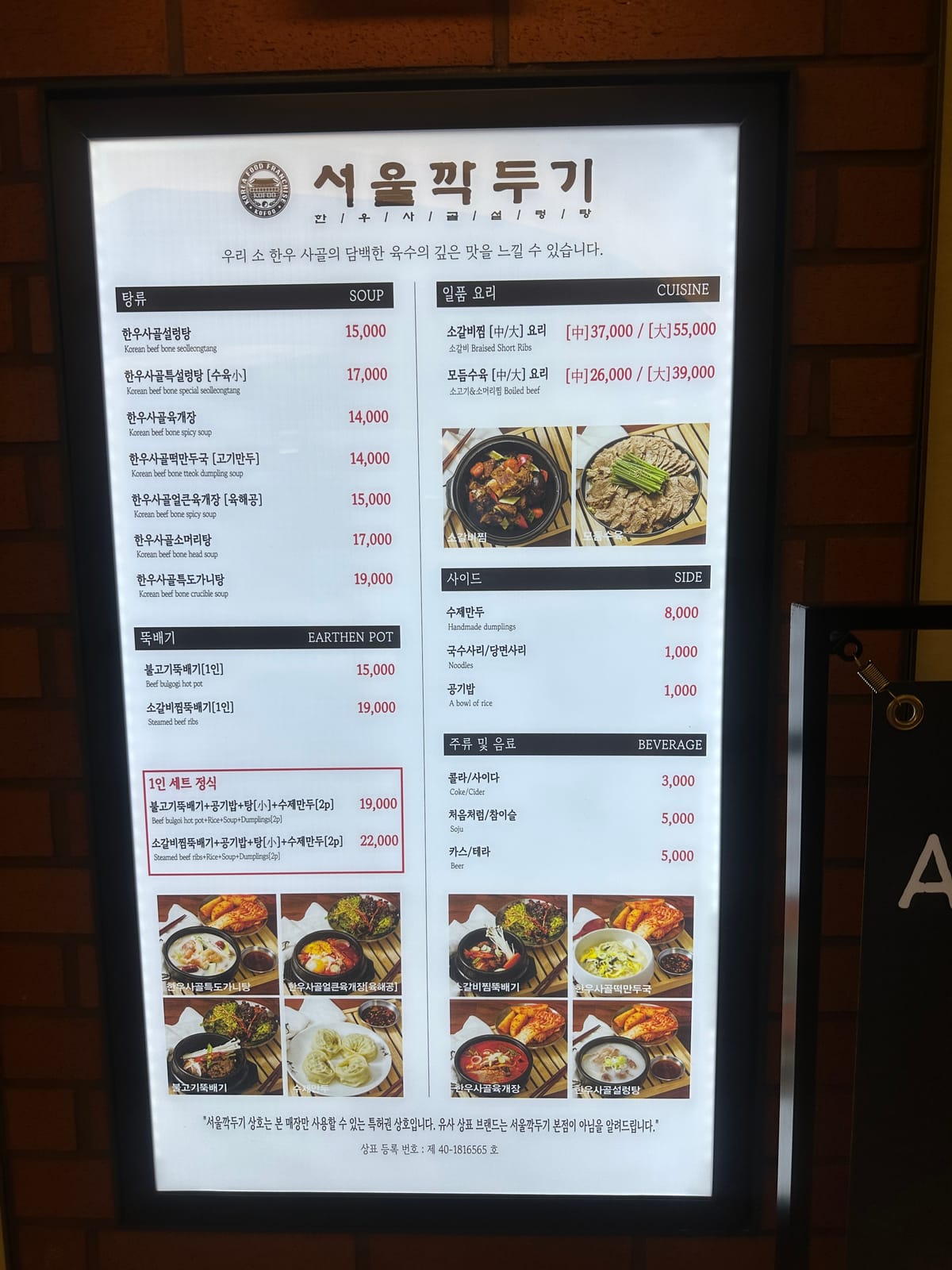 The light-box menu on the brick wall, with a trademark notice attached at the very bottom.
I have long believed that for seolleongtang, the kimchi has to be good. The lighter the broth, the more it is the kimchi that carries the flavor in the end. So this restaurant has basically stamped what I always say into its name. And the kimchi really is good.
What is interesting here is the public numbers. This restaurant has 1,490 reviews, and in the ranking of menu items visitors mention, number one is seolleongtang with 228 mentions and number two is kkakdugi with 213. The side dish is nearly level with the main dish. Seeing galbi at 128 and galbi-jjim (braised short ribs) at 114 far below, the gap does not look like an accident. It means the name is actually working.
You fetch the side dishes yourself from a self-serve bar. Kkakdugi, chopped green onion and napa cabbage kimchi are split among three stainless steel tubs. But the cabbage kimchi is not cut; whole heads go into the tub as they are. The setup is that you cut it with scissors. A place that staked its name on kimchi serves its kimchi whole.
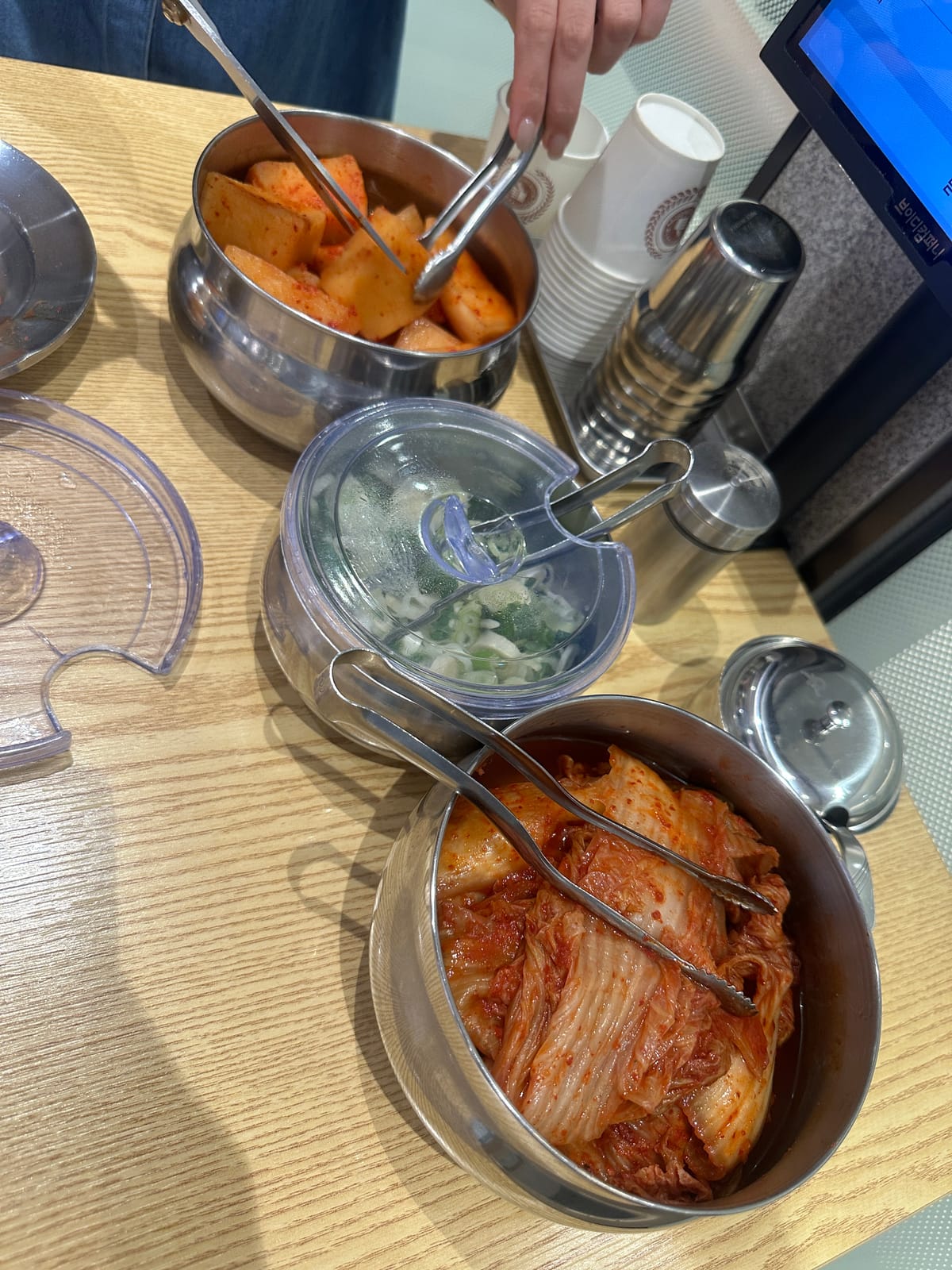 The self-serve side dish corner, with whole heads of napa cabbage kimchi in the lower steel tub.
With no route for carrying side dishes around, staff do not have to circle the dining room as much at the lunch peak, and leaving the tubs open in itself reads as a signal of confidence in the quality. (In terms of generosity alone, this place is practically cheating.)
To be honest, the taste is not always the same. There are two kinds, seokbakji (chunky radish kimchi) and cabbage kimchi, and their condition is a little different every time I come. This time the cabbage kimchi was clearly better. If they make it in-house, that kind of variation is only natural.
One more thing caught my eye on the branding side: a trademark notice. At the very bottom of the menu board there is a line saying that the name Seoul Kkakdugi can only be used by this restaurant brand and that brands with similar names are not the original. The trademark registration number is even written there, and the same notice appears once more on the table tablet’s idle screen.
Putting it in two places reads to me as a sign that they have been through that much. Using a word as common as kkakdugi for your name makes it easy to remember but hard to protect. They are paying the price of choosing an easily memorized name with two notices.
The hanwoo bone seolleongtang and handmade dumplings I tried for the first time
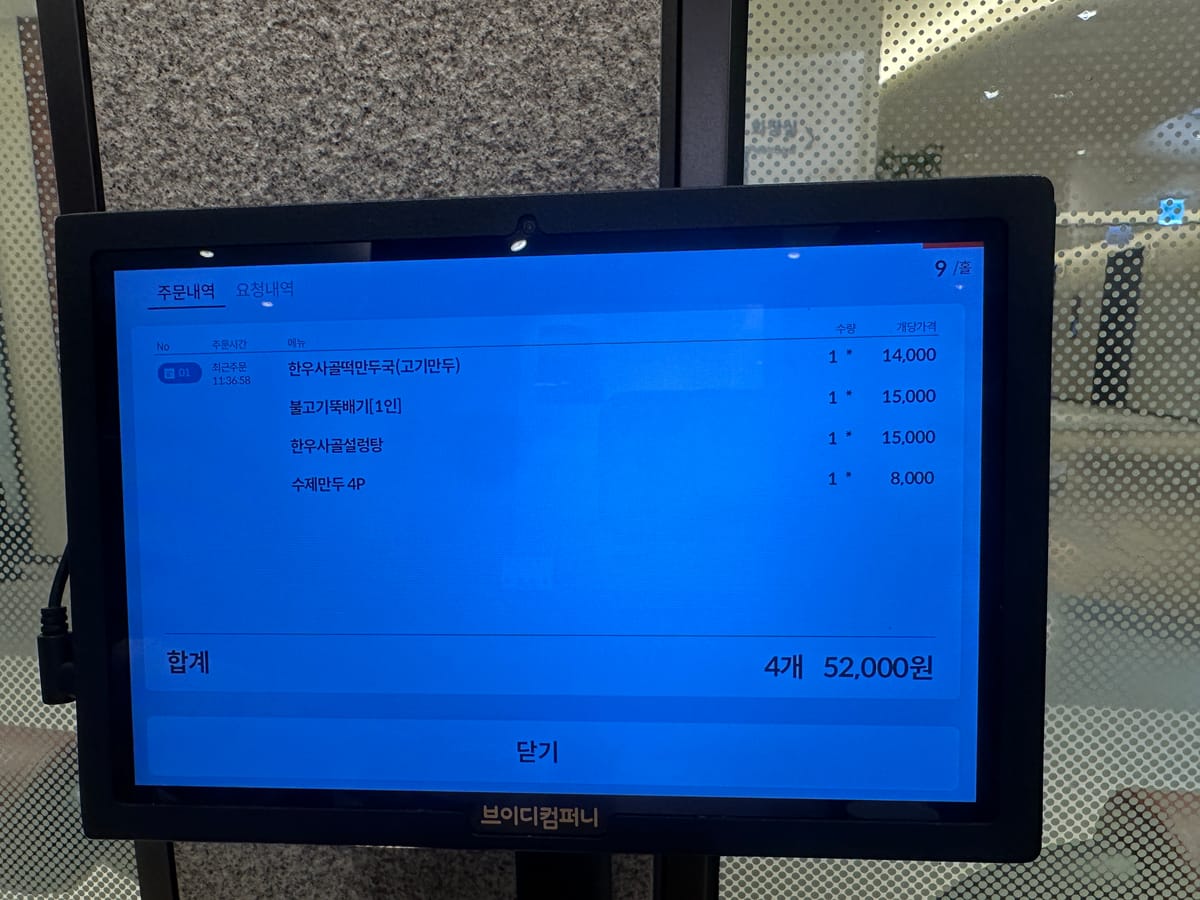 The order on the table tablet: three people’s soups and pots plus handmade dumplings, KRW 52,000.
You place your order on the table tablet. That day, the three of us ordered hanwoo bone seolleongtang at KRW 15,000, bulgogi ttukbaegi (bulgogi in an earthen pot) at KRW 15,000 and hanwoo bone tteok-manduguk (rice cake and dumpling soup) at KRW 14,000. On top of that, we added one order of handmade dumplings, KRW 8,000, as a side for everyone to pick at. The total was KRW 52,000, and the order time was stamped 11:36.
Soups are priced between KRW 14,000 and KRW 19,000. Yukgaejang (spicy beef soup) is KRW 14,000, seolleongtang KRW 15,000, someori-tang (beef head soup) and special seolleongtang KRW 17,000, and special dogani-tang (beef knee soup) KRW 19,000. For people who come alone, the set meal for one is KRW 19,000 and comes with an earthen pot dish, a bowl of rice, a small bowl of soup and two handmade dumplings. Rice and extra noodles are KRW 1,000 each.
| Menu (September 2026) | Price |
|---|---|
| Yukgaejang | KRW 14,000 |
| Hanwoo bone tteok-manduguk | KRW 14,000 |
| Hanwoo bone seolleongtang | KRW 15,000 |
| Bulgogi ttukbaegi | KRW 15,000 |
| Someori-tang, special seolleongtang | KRW 17,000 each |
| Special dogani-tang | KRW 19,000 |
| Set meal for one | KRW 19,000 |
| Handmade dumplings | KRW 8,000 |
| Rice, extra noodles | KRW 1,000 each |
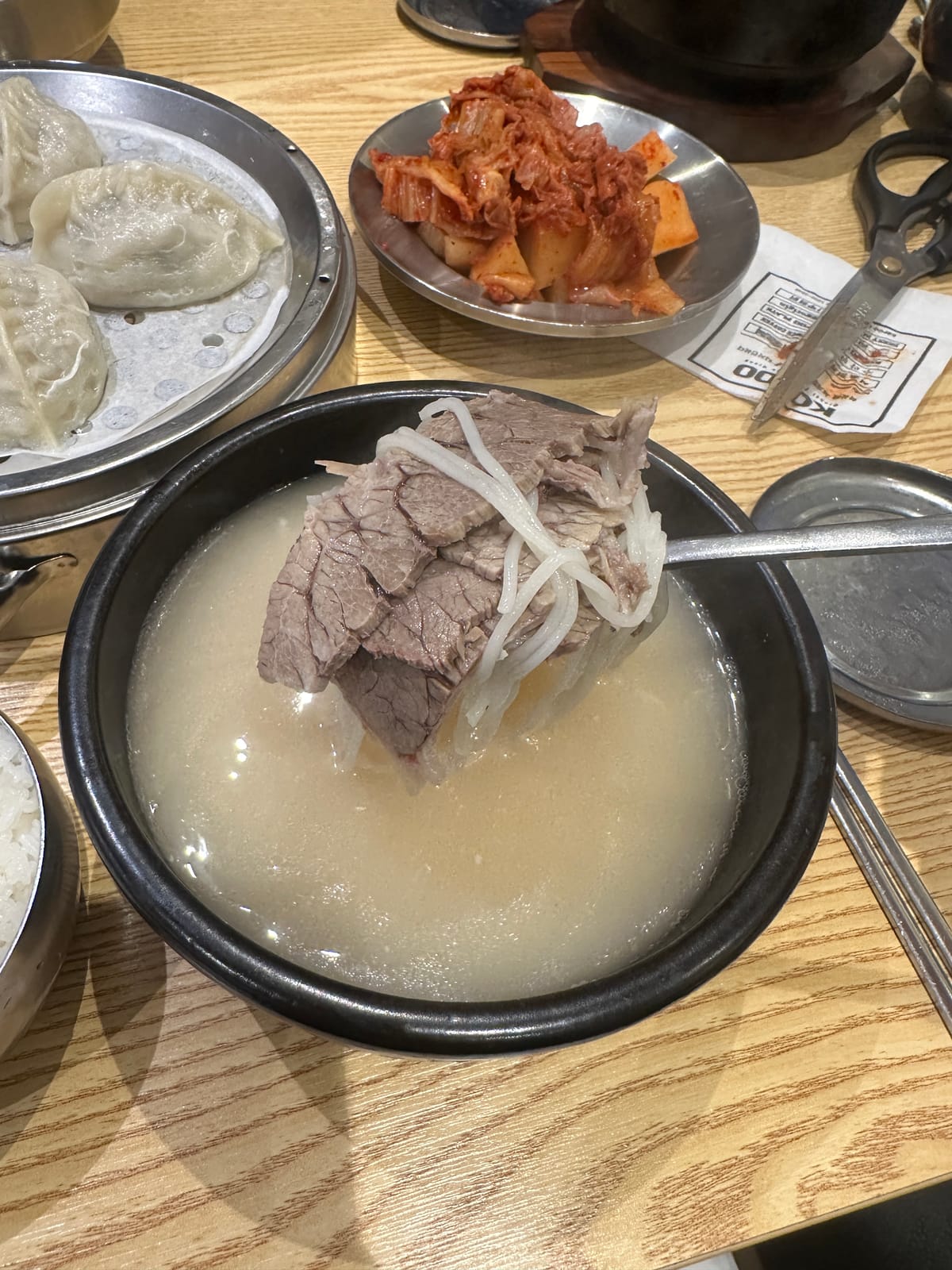
What I ate was the seolleongtang. The main dish, ordered for the first time on my third visit, and to give you the conclusion first: it was good.
Boiled beef is heaped on top of the milky broth, served with white somyeon noodles tucked in between. The meat is tender. It does not hold out stubbornly and then snap; even pressed with a spoon, the grain comes apart.
What I liked most was the seasoning. The broth has almost no salt in it. So you have to adjust it yourself with salt and pepper. People want very different levels of seasoning in this dish. If the kitchen seasons it before sending it out, it will inevitably be too salty or too bland for someone. Leave out the base seasoning entirely and hand it over to the table, and that variation disappears. (One spoonful and you immediately understand why the salt and pepper shakers sit in such a visible spot on every table.)
I ordered the handmade dumplings to share with my companions. There are four in the steamer, and the wrappers are thin enough that you can almost see the filling.
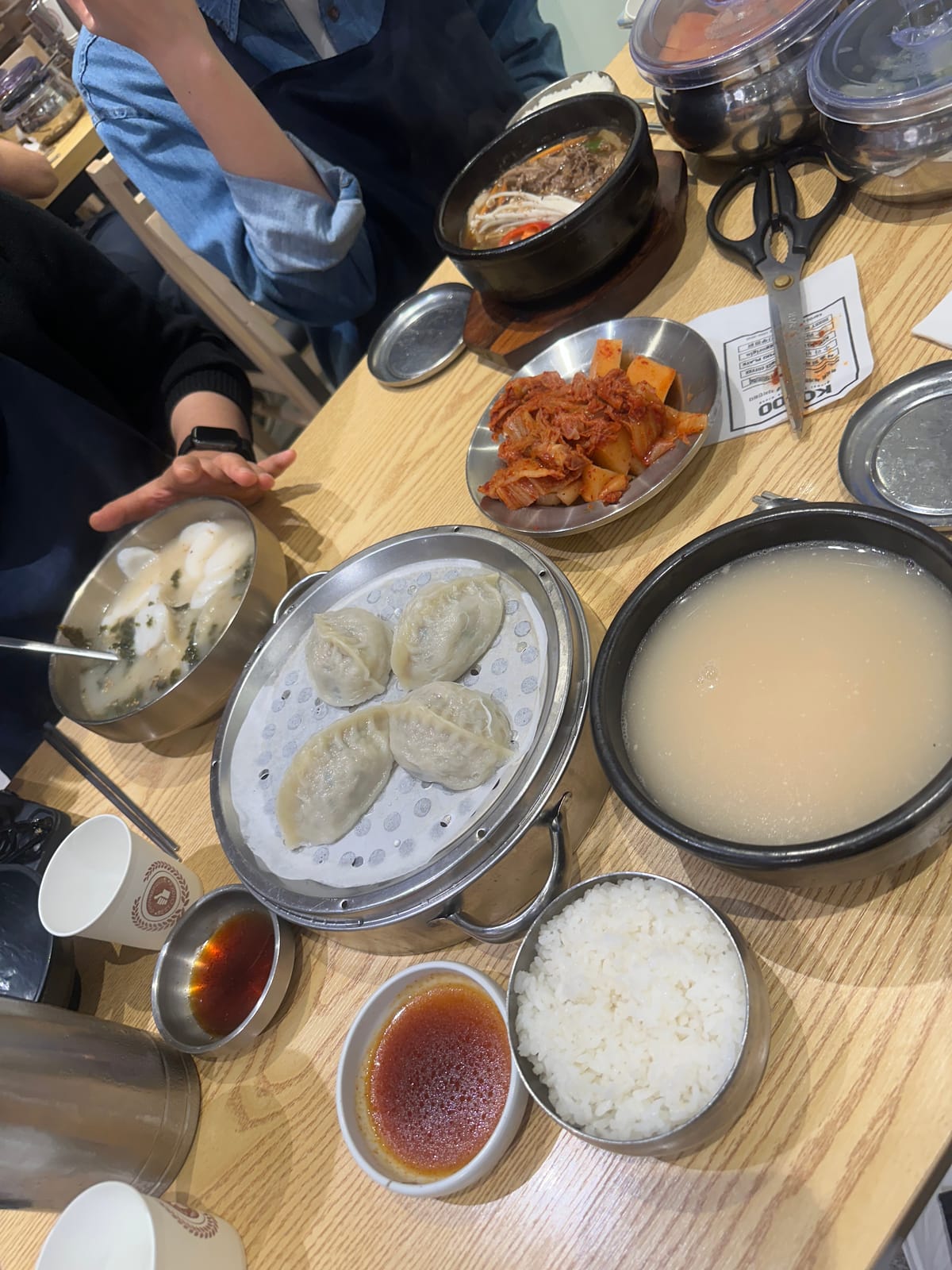 Once the soup, the earthen pots and the dumplings were all laid out, there was not an empty spot on the table. Ha.
The bulgogi ttukbaegi and the hanwoo bone tteok-manduguk came to the same table. With three earthen pots and a steamer on one table, it is full. The tables at Seoul Kkakdugi COEX are on the generous side, so they can take this much.
A seolleongtang restaurant that opens at 7 AM
On the operations side, what stood out most was the opening hours. It opens at 7 every morning. It closes at 9 PM, with last order at 8:30 PM. Considering Brickurry opens at 10:30, that is quite a gap.
Hot soup is a dish naturally eaten for breakfast, and COEX is a place where many people are on the move from early morning because of exhibitions and trade fairs. It looks designed to open early and catch that demand first. Of course, I have never been there at 7 AM, so I do not know what that time slot is actually like. Among Korean restaurants around COEX, few keep their lights on from 7 AM.
A framed company introduction hangs on the wall, decorated with the family brand logos, with a country-of-origin board next to it. That frame shows that this is not a single restaurant. It lists the family brands of a group called KOFOO, with a separate brand standing for each category: coffee, Jeju abalone, noodles, jjimdak (braised chicken), even tteokbokki. Seoul Kkakdugi handles the soup category among them. The company history is written from 1985.
Instead of piling more dishes onto one brand, they set up a separate name for each category. Put everything under one name, and it gets blurry what the place actually sells.
The country-of-origin board is posted side by side on the same wall. Hanwoo bones and hanwoo mixed bones are domestic, beef tendon is from the United States, the braised ribs are from Australia, the chili powder is from China, and the soft tofu is imported. A place that puts “hanwoo” big on its sign not hiding even its imported ingredients makes me trust it more.
We put in our order at 11:36, and there was no line then. The dining room is large and the tables are well spaced, so it is not a layout where waits stretch out long. That said, I could not check what it is like after 12:00.
The menu has a separate set meal for one, and the earthen pot dishes are marked for one person, so it looks like you will not feel awkward coming in to eat alone. There are high chairs for small children, and long tables where several people can sit together.
For parking you would have to use the City Airport Tower car park, but I only ever walked there, so I could not confirm the fees or validation conditions. Once again, I am writing down what I do not know as something I do not know.
And I have to talk about the same building once more. This is the only seolleongtang restaurant on this dining floor. In my first post, about Brickurry, I wrote that the tenant mix seemed set up so competing menus do not overlap, and the same picture came up in the second. I still have not seen the building’s merchandising criteria myself, so I cannot say for sure.
Thanks to that, I now have one rule of thumb for deciding between Korean and Western food at COEX. Brickurry opens at 10:30 and its hamburg steak on its own is KRW 13,000; this place opens at 7 and a bowl of soup is KRW 15,000. On days you are moving early in the morning or need a hot soup, this one; on days you want a plate topped with sauce, that one. (Of course, that day I did not even get to use the rule. My partner had said we were going here.)
Epilogue: Not for the office workers here, but for people passing through for a day
Who I recommend it to is the same as for the first post. For people who work around here, there is honestly nothing new about this place. It has piled up 1,490 reviews, and people who work at COEX already know all the places worth going to.
The people I want to write for are the ones passing through this neighborhood for a day. People who come for an exhibition or a trade fair and wander around at lunch not knowing where to eat Korean food at COEX. After walking around a venue for a long time, one hot bowl of soup is far more welcome than anything fancy.
If you searched for Korean food at COEX and ended up all the way at Seoul Kkakdugi COEX, you can go ahead and save it. 555 m from Samseong Station Exit 5, open from 7 in the morning.
In three visits, I was satisfied all three times without ever eating the main dish. So what this place is confident about had been written on its sign from the very beginning.
Kkakdugi.
When you eat gukbap or seolleongtang, do you taste the kimchi first? Thanks for reading, and your likes and comments are a big help in keeping Hogal growing.
Related
- Japanese Curry Near COEX: Brickurry Hamburg Steak Review
- Menshoku COEX: Shoyu Ramen Without the Lunch Line
- Where to Eat Near COEX, Seoul: 12 Restaurants We Paid For
Read the original Korean review on Naver (with all photos): 코엑스 한식 맛집 서울깍두기 코엑스점 한우사골설렁탕 세번 방문 내돈내산 솔직후기