Nampodong Sujebi COEX Mall (남포동수제비 코엑스몰점) serves sujebi, a Korean soup of hand-torn wheat dough, on the B1 dining floor of the City Airport Terminal building, about 434 m from Samseong Station Exit 5 near COEX. The basic bowl is KRW 9,000, the anchovy broth finishes very cleanly, and the dough is unusually thin and wide. It is not a wow kind of soup, but it tastes exactly the clean way you imagine, and that is what I liked about it.
| Restaurant | Nampodong Sujebi COEX Mall (남포동수제비 코엑스몰점) |
| Category | Korean snack food and noodle soups (bunsik) |
| Address | B1, 22 Teheran-ro 87-gil, Gangnam-gu, Seoul (City Airport Terminal B1 dining floor) |
| Getting there | About 434 m from Samseong Station Exit 5; down the side corridor between Gogung Jeonju Bibimbap and Mugyo Nakji |
| Recommended | Nampo teukmi sujebi, tuna rice balls |
| Hours | Last order 19:30 |
| Phone | 02-551-3999 |
| Wait | None when we arrived at about 11:40 on a weekday |
| When we went | Lunch on Friday, October 2, 2026; we paid for our own meals (menu and prices as of that day) |
Hello, I’m Hogal, a marketer who runs on curiosity. A weekday lunch near COEX, and today it is sujebi. This is my record of Friday, October 2, 2026: we walked in at around 11:40, paid for our own food and ate.
Prologue: B1 of the City Airport Terminal, down a side corridor
The lineup was the same again: my partner, my partner’s coworker and me. Somewhere along the way the three of us have become fixed lunch mates. These days the B1 dining floor of the City Airport Terminal building is our lunch route, and Seoul Deopbap, my last review, was on the same floor. (If you are in the mood for ramen, there is Menshoku over on the City Airport Tower side.)
This time we went a little further in. Follow the corridor that opens between Gogung Jeonju Bibimbap and Mugyo Nakji, and you will see a wooden sign: Nampodong Sujebi COEX Mall.
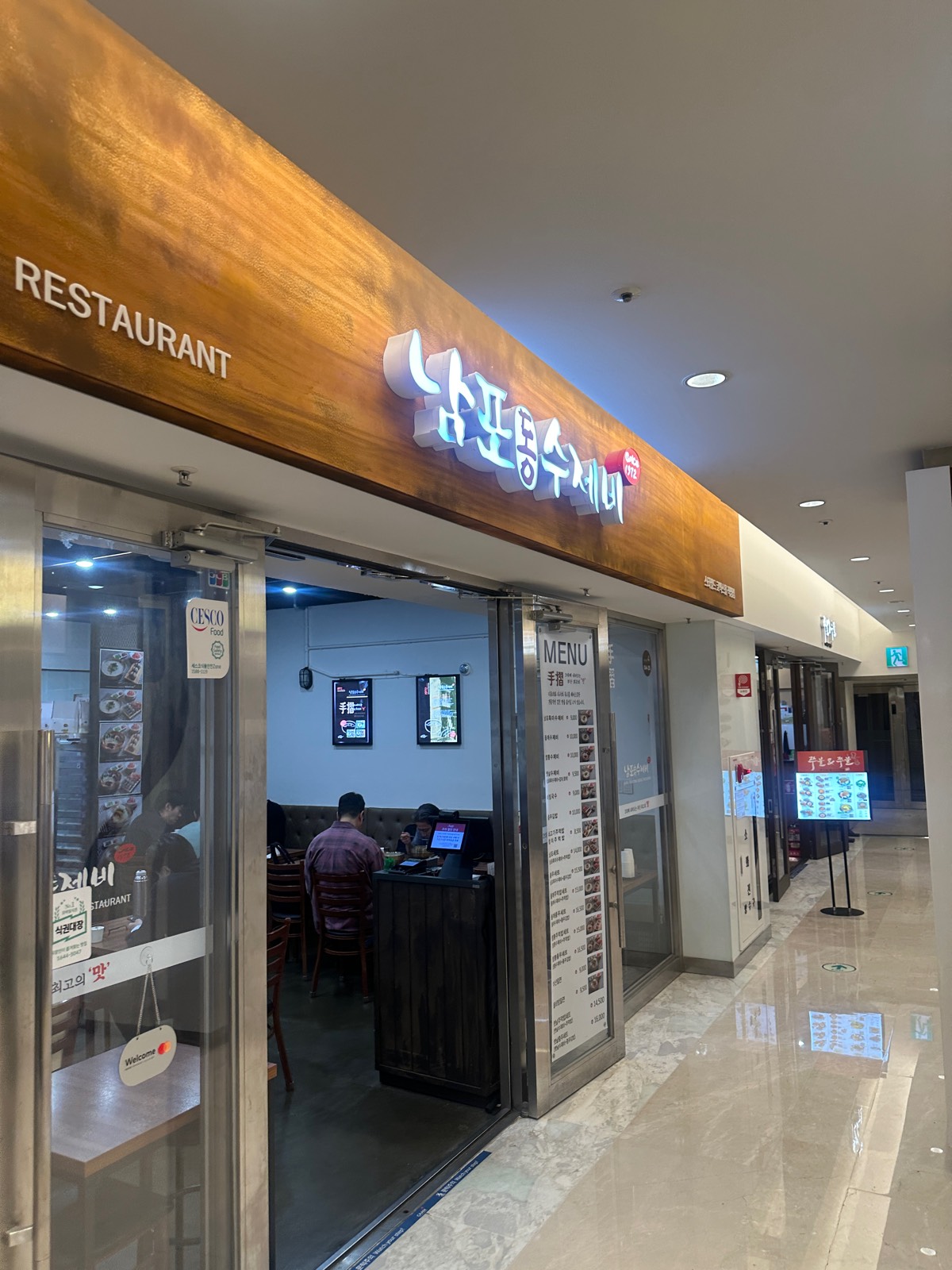 White letters glow on the wooden sign, and a tall menu board stands by the door.
At the end of the sign, inside a red circle, it says “Since 1972.”
A marketer’s view: the number 1972 and the number 9,000
What one line of “Since 1972” does
The first thing that speaks to someone seeing this place for the first time is a number. “Since 1972” is on the sign, on a corner of the entrance menu board and on the dining room wall. In the top left of the menu board there is even a red badge that reads “Busan matjip,” a Busan favorite (Nampo-dong is a neighborhood in Busan).
Honestly, I walked in knowing nothing about the original restaurant. When I looked it up afterward, another branch’s description mentions a taste handed down for two generations in Busan. I could not confirm how this branch is related to the original.
Even so, for a first-time customer, the single number 1972 does a lot of explaining. It is a signal that this place has been doing this for a long time, and the more a dish depends on dough torn off by hand, the more that signal turns into trust.
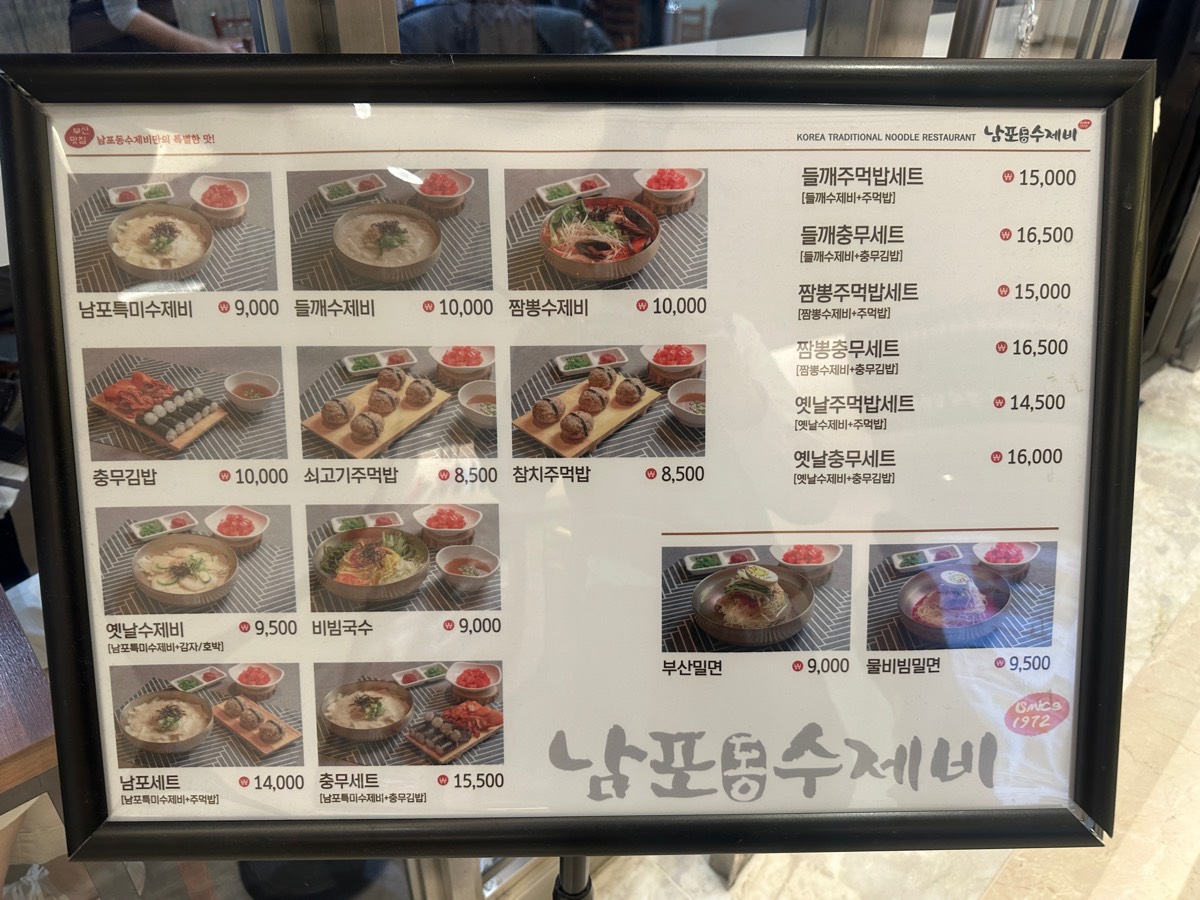 The entrance menu board: ten single dishes and eight sets on one sheet, with the Since 1972 logo in the bottom right. Dish names are in Korean only.
A menu board built to grow lunch into a set
The structure of the menu board caught my eye too. The single dishes are four soups, three rice dishes such as chungmu gimbap and rice balls, and three noodle dishes such as milmyeon and bibim-guksu. The basic Nampo teukmi sujebi is KRW 9,000, and the tuna rice balls and beef rice balls are KRW 8,500 each.
Then eight sets take up the whole right half of the board. The Nampo set adds rice balls to the basic soup for KRW 14,000, a combination that costs KRW 17,500 if you order the two separately. The jjamppong chungmu set adds chungmu gimbap to the jjamppong sujebi for KRW 16,500, again KRW 3,500 less than the single prices added up.
It is a design that turns a one-bowl lunch into a full table. The spend per customer goes up, yet the customer feels they got a discount. (In the end, not one of the three of us ordered a set.)
| Menu (October 2026, from the menu board) | Price |
|---|---|
| Nampo teukmi sujebi (the basic sujebi) | KRW 9,000 |
| Yetnal sujebi (basic sujebi with potato and zucchini) | KRW 9,500 |
| Deulkkae sujebi (perilla seed) | KRW 10,000 |
| Jjamppong sujebi | KRW 10,000 |
| Tuna rice balls / beef rice balls | KRW 8,500 each |
| Chungmu gimbap (small rice rolls with spicy squid and radish) | KRW 10,000 |
| Bibim-guksu / Busan milmyeon | KRW 9,000 each |
| Mul-bibim milmyeon | KRW 9,500 |
| Nampo set (basic sujebi + rice balls) | KRW 14,000 |
| Other sets (sujebi + rice balls or chungmu gimbap) | KRW 14,500–16,500 |
Where KRW 9,000 stands on a basement dining floor
The price gets sharper when you line it up with my other records from the same neighborhood. At Seoul Kkakdugi COEX, a bowl of soup was between KRW 14,000 and KRW 19,000. At Menshoku, ramen started at KRW 13,000. Seoul Deopbap, on this same dining floor, was in the low KRW 10,000s. At Nampodong Sujebi, a bowl starts at KRW 9,000.
Whether you are searching for sujebi near COEX or just find lunch prices around COEX a bit much, the starting line here is low. In a neighborhood where a meal in the KRW 10,000s is the default, a bowl of soup that starts under KRW 10,000 is a niche in itself.
What the three of us ordered: two dishes
Our order split two ways. My partner and the coworker had the basic Nampo teukmi sujebi, and I had the tuna rice balls. Two bowls and one plate of rice balls came to KRW 26,500 for the three of us. No sets, just singles.
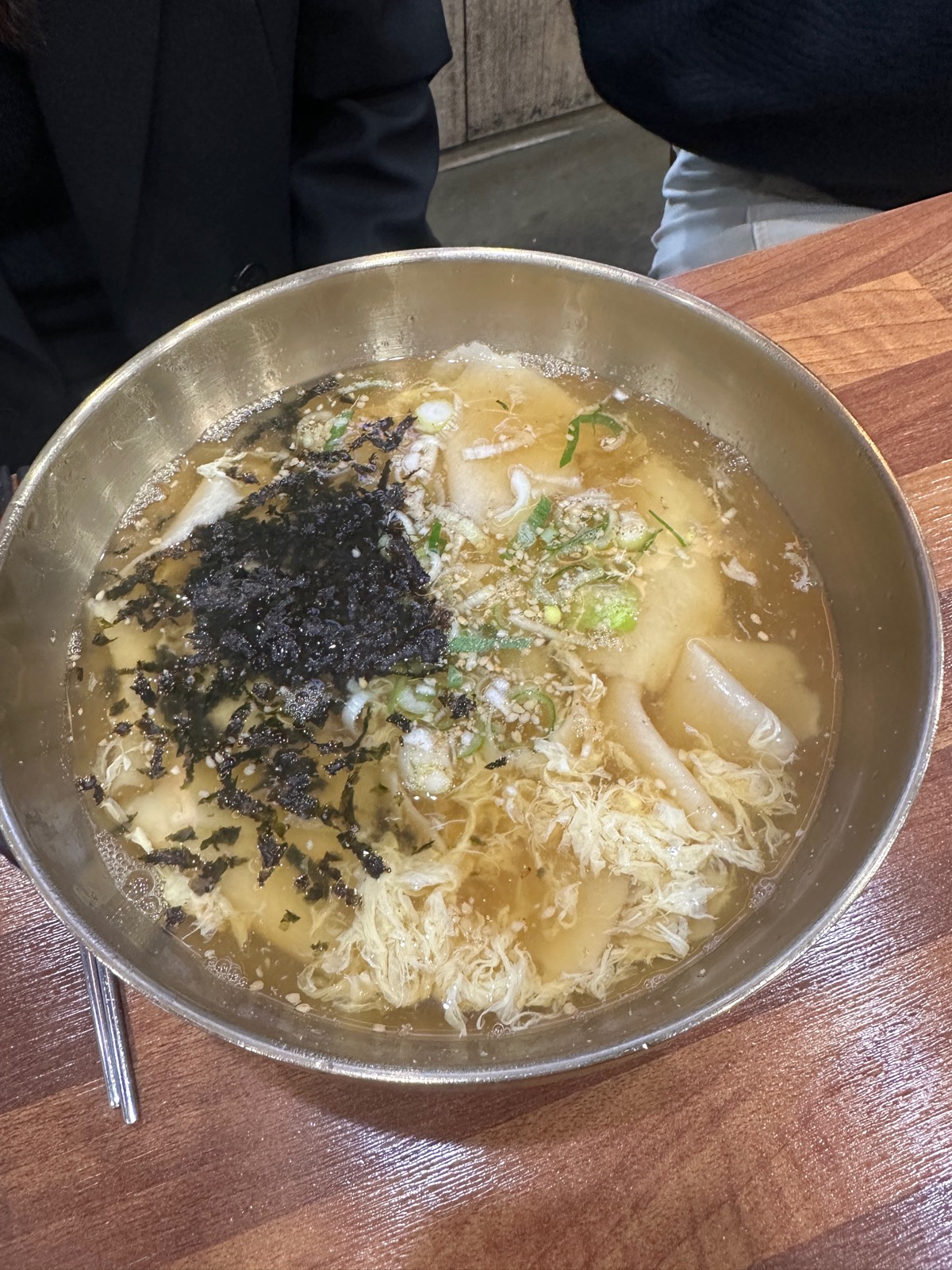
Nampo teukmi sujebi, KRW 9,000: an anchovy broth that reminds you of janchi-guksu
The bowl is wide. On one side of the clear broth there is a heap of crushed seaweed, and sliced green onion, sesame seeds and softly scrambled ribbons of egg cover the top. The broth is anchovy-based, the kind that immediately brings janchi-guksu (Korean banquet noodles) to mind.
What impressed me was the finish. It ends really cleanly. It is not an “oh my god, this is amazing” kind of taste. Instead, you get exactly the clean broth you would imagine, and that is what I liked.
Then the dough. It is not thick. It is really thin. Rather than chunky pieces pinched off one by one, it feels closer to a broad noodle. That made it unusual, and it gives the same dish a different taste. If I end up remembering this place for its sujebi, it will probably be because of that thin dough. (You can see thin, folded pieces of dough through the broth in the photo.)
Tuna rice balls, KRW 8,500: good precisely because they are not tuna mayo
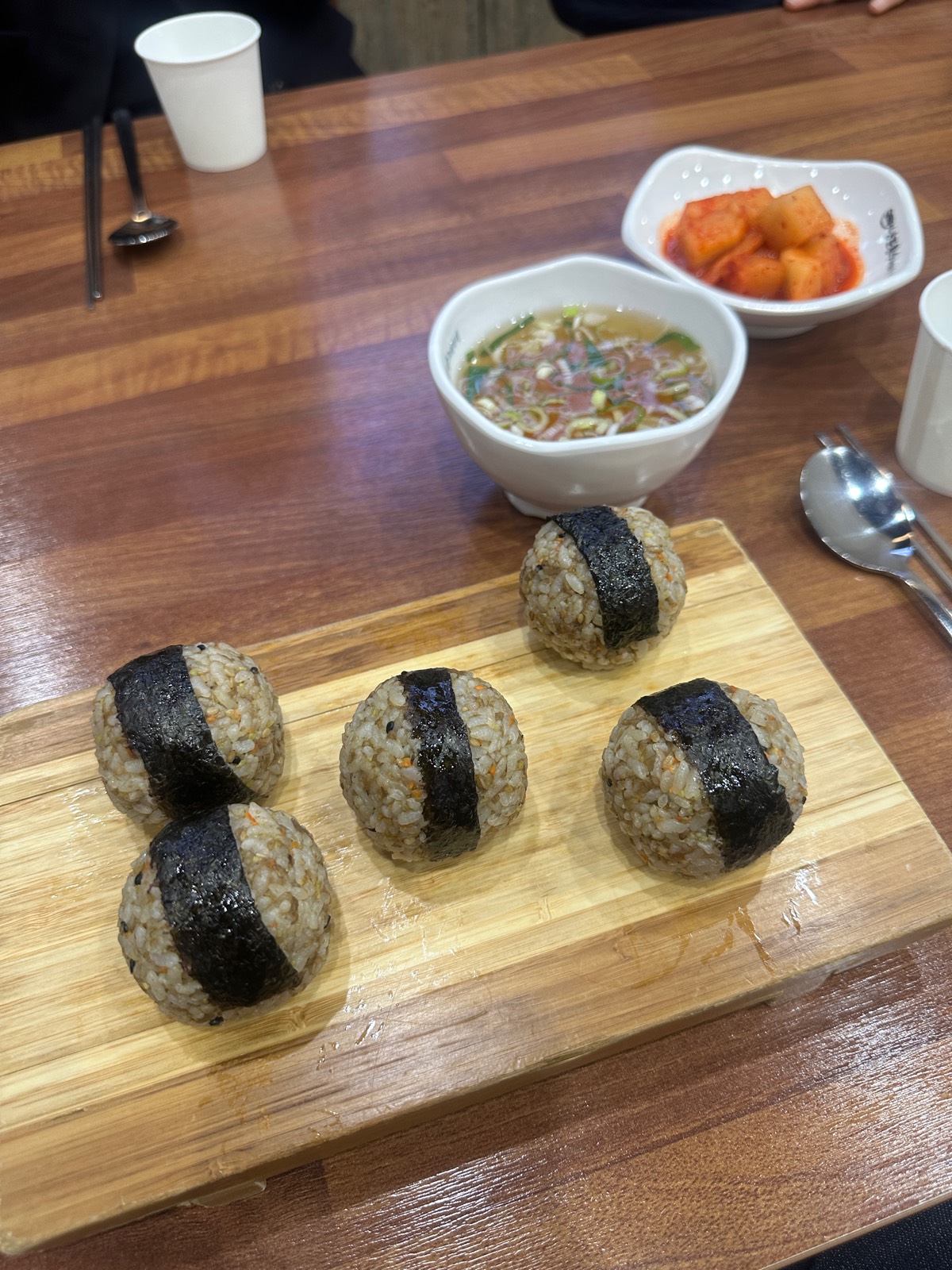 Five balls, each with a band of seaweed. This was my share today.
Five rice balls arrive on a wooden board, with kkakdugi (cubed radish kimchi) and a small bowl of soup alongside. Sesame seeds and finely chopped vegetables are tucked between the grains of rice. They came out neat and well made. Each ball was one bite for me, or about two or three bites for the women at our table.
The taste is clean and really nutty. When you hear “tuna rice ball,” tuna mayo usually comes to mind first, but these are not that kind, so they are not greasy at all. It feels like eating real rice, with the nutty aroma of tuna and sesame rising over it. (Of the three of us, I was the only one who picked a rice dish, haha.)
No wait at lunch, and what the reviews say
There was no wait. We arrived at about 11:40 and sat down right away. I have been working my way through a few places along this line lately, and not having to queue is a real plus.
By then the dining room was filling up with lunch customers, between the wooden tables and the sofa seats. Given the menu, tables seem to turn over quickly too: a bowl of soup and a plate of rice balls are not dishes you sit over for long. On an office lunch where you are slicing one hour into pieces, that matters quite a bit.
Filling in the blanks with visitor reviews
After the visit I skimmed the restaurant’s Naver Place visitor reviews (as of October 2, 2026). Of 323 people who voted on review keywords, 246 picked “the food is tasty” and 97 picked “good for eating alone.” Some reviewers said the food comes out fast, and others that the prices are kind for a restaurant inside COEX. One review said the dough is torn fresh to order.
After sujebi, the dishes mentioned most were gimbap and chungmu gimbap, and one reviewer even called it a chungmu gimbap spot. There is an opposing view as well: one review said the portion seemed a little small but the taste was good. On the other hand, 46 people voted that the portions are generous, so portion size looks like a point where people differ. The large number of “good for eating alone” votes also seems to fit a menu that comes out fast and lets you get up fast.
Good to know before you go
First, location. It is inside the B1 dining floor of the City Airport Terminal building, down the side corridor between Gogung Jeonju Bibimbap and Mugyo Nakji. It is about 434 m from Samseong Station Exit 5, an easy walk if you are looking for lunch near Samseong Station.
Second, ordering. If you plan to have rice balls with your soup, the Nampo set is KRW 3,500 cheaper than ordering the two separately.
Third, timing. If you are dropping by for dinner, just remember that last order is 19:30.
A sujebi meal near COEX where you sit down without waiting, finish a bowl of soup and get up again: if you are looking for lunch along this line, it is well worth factoring in.
Epilogue: if you have business at the City Airport, a bowl of sujebi
Nampodong Sujebi is not a flashy place. Even among the Korean options around COEX, it sits on the light, mild side: the clean finish of anchovy broth, thin and wide dough, and prices that start at KRW 9,000. If you have business at the City Airport Terminal, I recommend solving your meal on this dining floor. The same goes for days when you want to finish lunch near COEX without standing in line.
Next time I plan to try the jjamppong sujebi. Or maybe the perilla one, haha. Then again, jjamppong with chungmu gimbap sounds like a pretty good combination, and conveniently, the menu board lists a jjamppong chungmu set for KRW 16,500. (So I end up back at the sets after all, haha.)
That some broths are good precisely because they taste exactly the way you imagined.
Which do you prefer, thick dough or thin dough? Thanks for reading, and your likes and comments always help me keep going.
Related
- Seoul Deopbap COEX Mall: Brown Rice Bowls from KRW 11,900
- Seoul Kkakdugi COEX: Seolleongtang Near Samseong Station
- Menshoku COEX: Shoyu Ramen Without the Lunch Line
Read the original Korean review on Naver (with all photos): 코엑스 수제비 남포동수제비 코엑스몰점 두툼하지 않고 얇아서 색다른 맛 내돈내산 솔직후기