Papaya Leaf COEX (파파야리프 코엑스점) is a modern Asian restaurant on the B2 floor of the Oakwood Hotel, connected to Starfield COEX Mall and about 425 m from Bongeunsa Station Exit 7. One menu covers Thai, Vietnamese, Indonesian and Singaporean dishes, portions are large, and the room looks like Southeast Asia rather than a mall basement. After four or five visits, my conclusion is simple: this place is really good at bun cha.
| Restaurant | Papaya Leaf COEX (파파야리프 코엑스점) |
| Category | Asian, modern Asian cuisine |
| Address | 2A05, B2, Oakwood Hotel (Convention Annex), 58 Teheran-ro 87-gil, Gangnam-gu, Seoul |
| Getting there | About 425 m from Bongeunsa Station Exit 7; connected to Starfield COEX Mall |
| Recommended | Jeju pork bibim bun cha, basil pork (moo sab) rice |
| Hours | Last order 21:00 |
| Reservation | Weekday lunch from 3 people only; no bookings weekdays 11:30–13:00 |
| Group seating | 6–16 people |
| Parking | Oakwood Hotel parking area, 1 hour free with registration |
| When we went | Lunch on Thursday, October 1, 2026, just after 11:30, with my partner; we paid (menu, prices and booking rules per Naver Place at the time) |
Hello, I’m Hogal, a marketer who runs on curiosity. This time it was a weekday lunch near COEX for two, just my partner and me. This is my record of Thursday, October 1, 2026: we walked in a little after 11:30, paid for our own food and ate.
Prologue: B2 of the Oakwood Hotel, my fourth or fifth visit
My office is in this neighborhood, so my lunch routes overlap every week. That is why I am writing up, one by one, only the COEX restaurants I have gone back to at least twice. (For days when you are craving seolleongtang, I already covered the answer in my Seoul Kkakdugi review.)
This time it is Papaya Leaf. It is where I go on days I want Thai food near COEX, and when I counted, I have been about four or five times.
 The Papaya Leaf COEX sign: a green papaya leaf logo perched on a round yellow light box.
Under the sign it says “Modern Asian Cuisine.” And sure enough, when you open the menu, pho, pad thai, tom yum goong, nasi goreng and even cereal shrimp are all there: Thai, Vietnamese, Indonesian and Singaporean dishes in a single book.
A marketer’s view: Thai food at COEX that turns the room into Southeast Asia first
The first thing that is different when you walk in is the color. The whole ceiling is golden yellow, and a long band of yellow indirect lighting runs along the walls. Below it, rattan-shaded pendant lamps hang in rows, and big tropical plants in the middle of the dining room divide the space like partitions. Bamboo-textured screens, green tiled pillars, even ceiling fans.
The visitor reviews describe the space better than I can. Many say things like “exotic interior with a palm-tree mood” or “the moment you sit down, you forget you are in the basement of COEX.” The review keywords include “great interior,” “spacious” and “cozy.”
COEX Mall is a place where restaurants are lined up one after another across a single corridor. From a window seat, the next restaurant’s sign is close enough to see clearly through the glass. In a setting like that, it is not easy to show a difference on taste alone, so I read it as a choice to turn the space itself into Southeast Asia. By the window, the COEX Mall corridor shows through the glass, and a large fan turns on the ceiling.
But in the end, what makes regulars is the menu. In a restaurant with dozens of dishes, what brings customers back is a weapon: one thing you know they do well. Looking at how often dishes are mentioned in the visitor reviews, shrimp leads with 241 mentions, pho and pad thai follow with 179 each, and bun cha has 77. So the most talked-about dishes are something else. But after four or five visits, I have reached one conclusion.
This place is really good at bun cha.
On the operations side, the booking rule stands out. Weekday lunch bookings are only for parties of three or more, and from 11:30 to 13:00 no bookings are taken. In other words, the busiest hour and a half is filled first come, first served. It looks designed to protect lunch turnover without reserved tables sitting empty. (The catch is that pairs like us just have to queue, haha.)
Two plates for two, and we ended up sharing
You order on a tablet attached to the table. My dish was the basil pork rice, and my partner’s was the Jeju pork bibim bun cha, KRW 31,000 together. We each ordered our own and ended up sharing both anyway. The order screen on the tablet showed just two lines, basil pork rice and bibim bun cha, for a total of KRW 31,000.
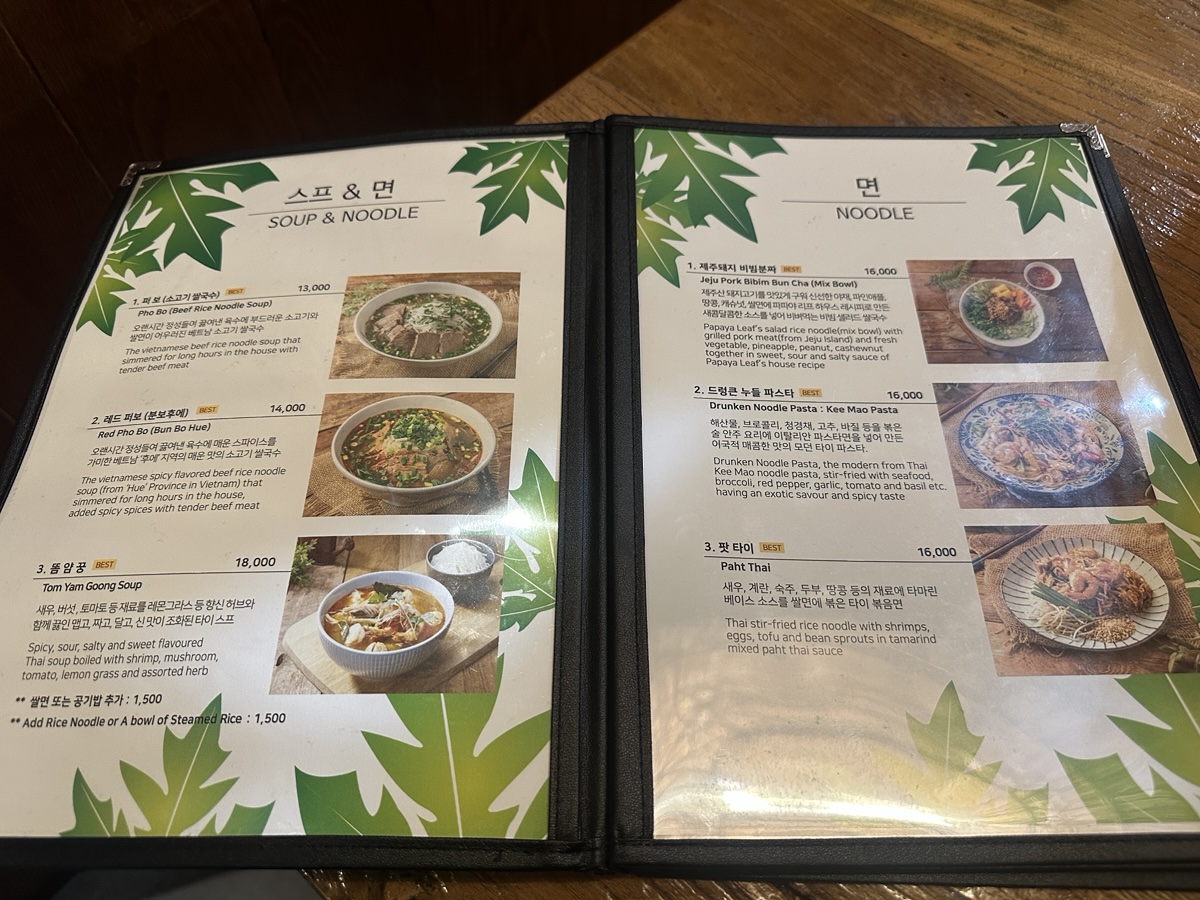 The noodle pages of the menu, with Korean and English names and short descriptions.
Jeju pork bibim bun cha, KRW 16,000: the reason I come here
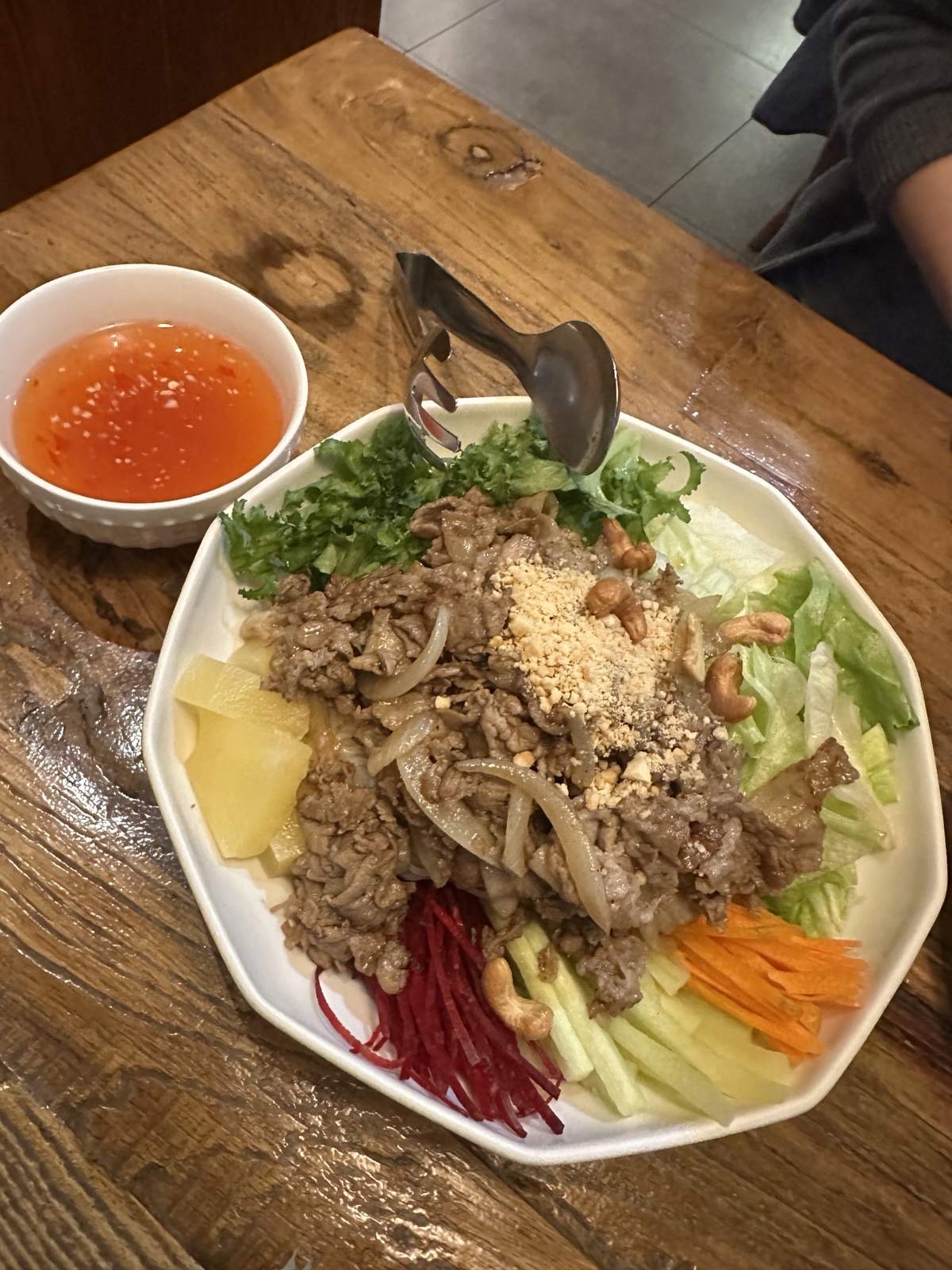
The menu describes it like this: grilled Jeju pork mixed with vegetables, pineapple, peanuts, cashews and rice noodles in a sweet and tangy house-recipe sauce, a bibim salad rice noodle dish.
The plate looks exactly like that description. In the middle is a heap of pork stir-fried with onion, topped with crushed peanuts and cashews. Around it, lettuce, curly lettuce, pineapple, shredded carrot, shredded red vegetables and pale green shreds are laid in a ring. On the side comes a small bowl of sauce with pieces of chili floating in it.
One line is enough for the taste: the bibim bun cha is really, really good. (I honestly have nothing longer to say about it, haha.) Visitor reviews also say the sauce is tasty and the variety of vegetables and toppings makes it fresh. I recommend everything in the bun cha family here.
Basil pork rice, KRW 15,000: always with a drink
This one is mine. Its name on the menu is basil pork (moo sab) rice: finely minced pork stir-fried with chili, basil and vegetables, set next to the rice, with one fried egg and a few slices of cucumber on the side.
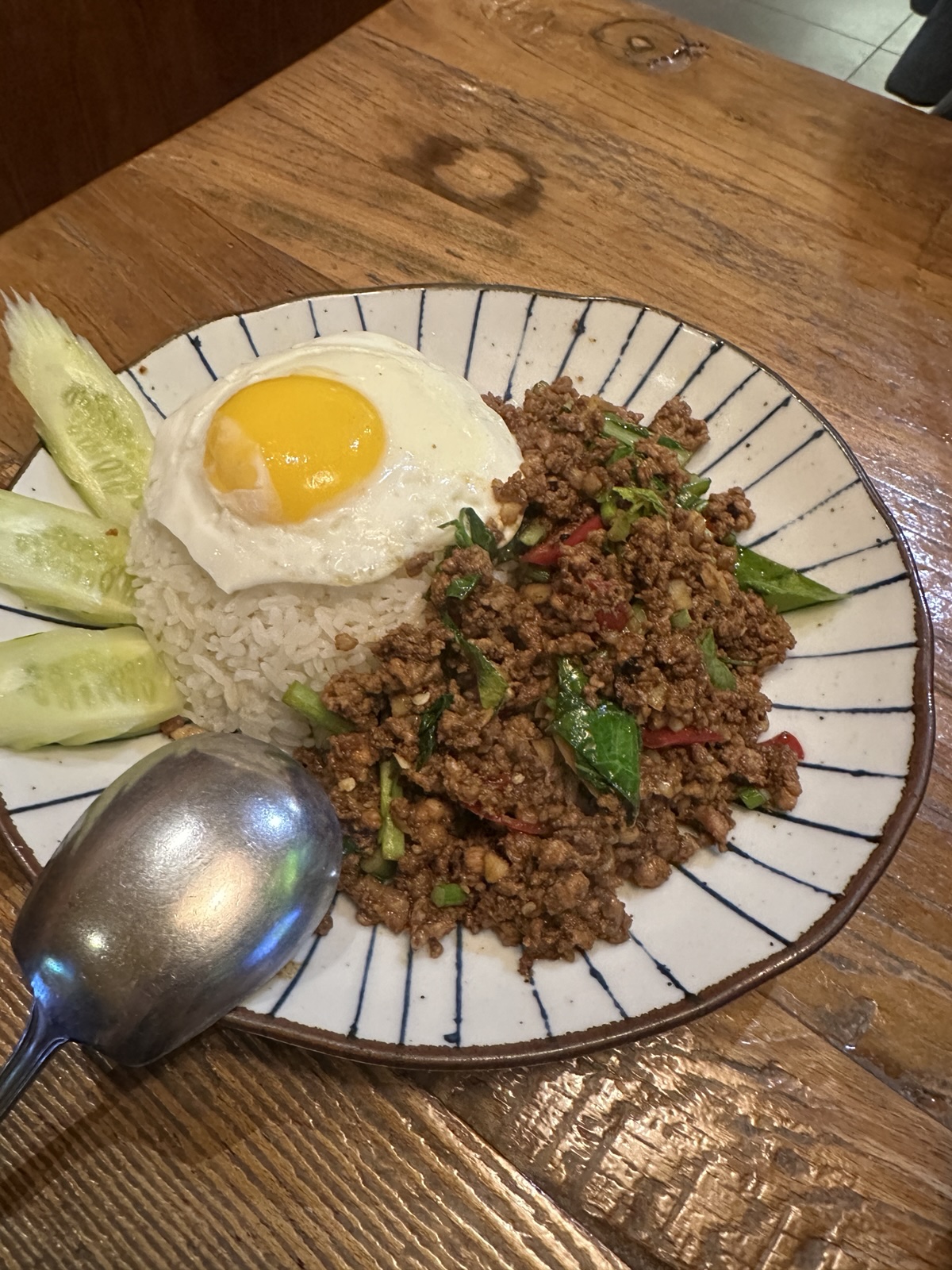 My basil rice, with a fried egg and its yolk sitting up round.
Honestly, I could not really pick out the basil aroma. It was still tasty, though. It is a little dry, and as you keep eating, it starts to feel a bit hard to swallow. So if you pick this dish, I recommend ordering a drink with it, like a beer or a cola. (On the menu, Tiger draft beer is KRW 8,000 and Coca-Cola KRW 3,500. At lunch, it has to be the cola, haha.)
If it is your first time having Thai food at COEX and you are worried about spices, many visitor reviews say the spices here are not strong. Cilantro is reportedly not added by default, and you can ask for it separately.
Portions and price: slightly above average, backed up by the portions
Portions are big. For a man, one dish is enough. For three women, two mains and one side would probably be about right. Sides start at KRW 4,000 for two vegetable spring rolls and KRW 7,500 for four menbosha (shrimp toast).
Prices run about KRW 15,000 to KRW 16,000 per person. That is not particularly high; it is around average, maybe slightly above. My other COEX record, Seoul Kkakdugi COEX, charged KRW 14,000 to KRW 19,000 for a bowl of soup, so it is not a number that stands out much.
Some visitor reviews say the food is good but the prices are a little disappointing, and some say certain dishes are sweet and rich enough to get tiring. Considering the portions, I thought it was fine. Above all, it tastes good.
| Menu (October 2026) | Price |
|---|---|
| Jeju pork bibim bun cha | KRW 16,000 |
| Basil pork (moo sab) rice | KRW 15,000 |
| Vegetable spring rolls (2) | KRW 4,000 |
| Menbosha (4) | KRW 7,500 |
| Tiger draft beer | KRW 8,000 |
| Coca-Cola | KRW 3,500 |
Getting there, and the lunch line
Papaya Leaf is on B2 of the Oakwood Hotel. It is connected to Starfield COEX Mall, and according to Naver Place directions, you come in through the Oakwood Hotel & Mall entrance in front of the Seoul Trade Center Post Office and the blood donation center. From Bongeunsa Station Exit 7, it is about 425 m.
If it is your first time, you may get lost. In that case, I recommend the AR walking directions in Naver Map. It is a feature I use a lot these days, and it finds the way well even inside COEX Mall. (Anyone who has ever lost their sense of direction in COEX Mall will welcome it, haha.)
Factor in a wait. It is a really hot spot at lunch, and there is always a line. This time, luckily, a table for two was free, so we sat right down without waiting. Do not expect it to be like that every time. (If you do not feel like queuing, Brickurry, where the lunch line moves quickly, is another option.)
Epilogue: Thai food at COEX, and bun cha
Among the options for Thai food at COEX, Papaya Leaf is the place where the bun cha is a sure thing. To be precise, it is a modern Asian restaurant that puts dishes from several Southeast Asian countries into one book.
It suits people who come to COEX for a trade fair or an exhibition and want a proper lunch, and people trying Southeast Asian food for the first time who are worried about spices. If you are looking for a good restaurant in COEX Mall, it is worth putting on your list.
Start with the bibim bun cha. In four or five visits, I have never had a dish I did not like. If you pick the basil rice, get a drink with it. It is a place I will keep going back to.
That even in the basement of COEX Mall, you can end up with a regular spot.
Do you have a lunch place you keep going back to no matter how many times you have been? Thanks for reading, and your likes and comments always help me keep going.
Related
- Seoul Kkakdugi COEX: Seolleongtang Near Samseong Station
- Japanese Curry Near COEX: Brickurry Hamburg Steak Review
- Menshoku COEX: Shoyu Ramen Without the Lunch Line
Read the original Korean review on Naver (with all photos): 코엑스 태국음식 파파야리프 코엑스점 비빔분짜 네다섯 번 다시 간 단골의 내돈내산 솔직후기